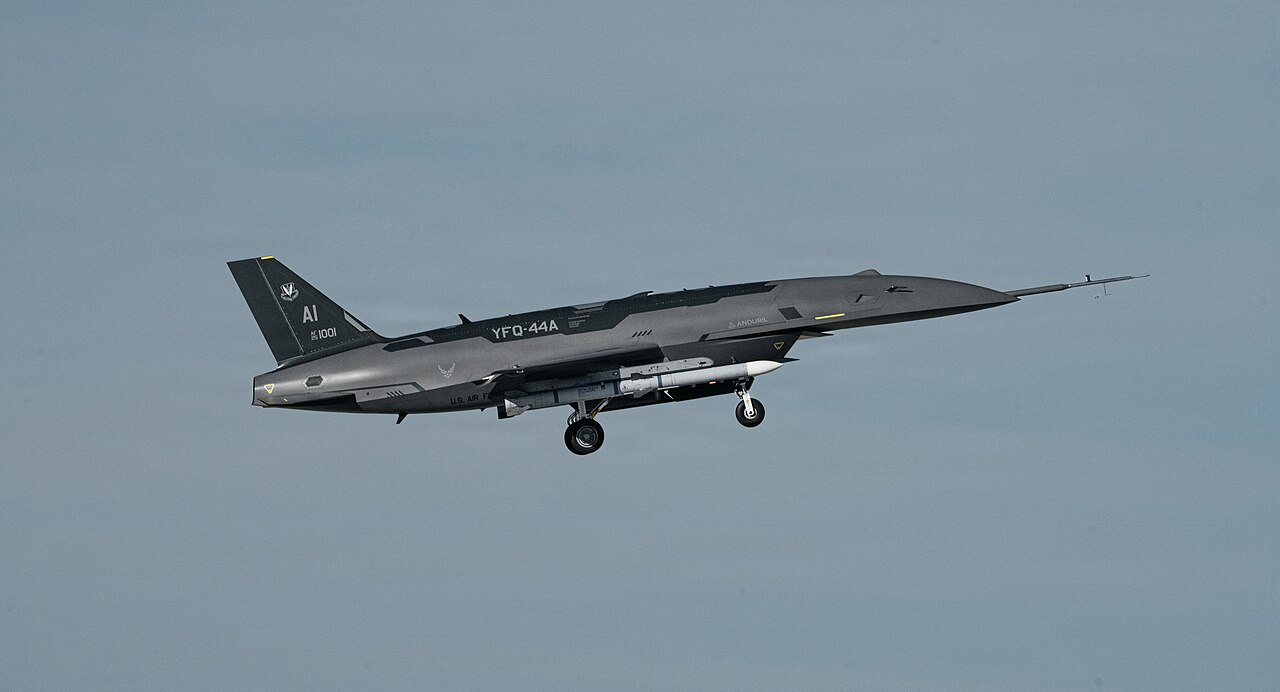
Air Force leaders have given initial production contracts to Anduril and General Atomics, which will both build collaborative combat aircraft based on their respective prototypes. Northrop Grumman’s self-financed offering was not selected.
Several companies also received money to develop software that will compete to pilot the service’s future fleet of drone wingmen.
The Increment 1 CCA contracts are for three lots of the drone wingmen, Air Force Col. Timothy Helfrich, the portfolio acquisition executive for fighters and advanced aircraft, told reporters during a briefing on Wednesday. He declined to say how many CCAs would be in each lot, nor how much each would cost.
Helfrich told Defense One in March that the Air Force was beating its goal of buying each CCA for about one-third of the cost of an F-35 fighter jet. The Defense Department is seeking nearly $1 billion to buy CCAs, 2027 budget documents show.
The announcement made winners of both Anduril and General Atomics in their two-year battle to furnish the Air Force’s first CCAs.
But more competitions are underway. Three firms are vying to build the drone wingman’s autonomous software platform. As well, nine vendors are competing for Increment 2 of the CCA program.
“By moving fast from competitive selection into full-scale manufacturing, we position ourselves
to field highly credible and combat-ready semi-autonomous systems to stay ahead of the pacing challenge,” Air Force Secretary Troy Meink said in a press release. “These contracts reaffirm our confidence in the strategic path forward for the program to procure over 150 combat capable CCA by the end of the decade.”
Both Anduril and General Atomics had setbacks while prototyping their CCA variants.
In April, General Atomics’ YFQ-42A Dark Merlin crashed at the company’s California airport after an autopilot program error. The incident halted flight testing for a little more than a month.
“This is an exciting day for our company and the nation,” General Atomics President David Alexander said in a Wednesday press release. “Moving to production on FQ-42A is the result of an extraordinary partnership and many years of investments between General Atomics and the U.S. Air Force. We’ve been preparing for this order, and manufacturing is already well underway.”
Anduril’s push for semi-autonomous software led to a months-long delay in notching its first flight. The company got its YFQ-44A Fury prototype off the ground in late October.
“We have been refining, testing, and iterating on our production system, in parallel with aircraft development, for the past two years. We have already implemented our full rate production processes and tooling on prototype aircraft, identifying and addressing issues during prototyping to streamline the transition into production,” Mark Shushnar, Anduril’s vice president for autonomous airpower, said in a statement. “The Air Force’s decision marks the first time that a new company has won a fighter aircraft program since the 1970s.”
The “Y” will be dropped from Anduril and General Atomics CCAs names to show they’re no longer prototypes.
Autonomy contracts
The Air Force also awarded CCA mission-autonomy production options to six companies.
A baseline, six-year contract vehicle was extended to Anduril, General Atomics, Lockheed Martin, Shield AI, Northrop Grumman, and RTX Collins, to create a pool of vendors eligible to build the autonomy software.
Anduril, Shield AI, and RTX Collins received additional Air Force production contracts and will compete to build the CCA’s final autonomous software. After six months, the Air Force plans to review those firms' initial performance. A second selection will follow that initial review, with a final selection expected by Summer 2027.
“Mission autonomy is the cornerstone of the CCA concept, and leveraging a competitive, multi-
vendor environment ensures we capture the latest technology,” Meink said in the news release. “This approach guarantees our airmen are equipped with state-of-the-art capabilities today but keeps the door open for the breakthroughs necessary to maintain air superiority.”
The Air Force said its software contract will use a “first-of-its-kind” award that is tied directly to reviews from the troops.
“The Air Force will only pay the entire licensing fee if a vendor provides a combat capability aligned with warfighter needs and feedback,” the news release said. “The licensing approach also allows the Air Force to award software licenses to any of the six vendors within the pool at any point over the six years.”
Earlier this year, the Air Force tested the government-owned Autonomy Government Reference Architecture, or A-GR, by placing RTX Collins software on General Atomics YFQ-42 aircraft and Shield AI’s technology on Anduril's YFQ-44 CCA. Compliance with the A-GRA is mandatory for vendors so the service can enable a mix-and-match approach to the software and hardware, the service said in the news release.
“Open systems architecture is critical in modern warfare,” Gen. Kenneth Wilsbach, the Air Force chief of staff, said in the news release. “It allows us to capitalize on the most advanced autonomy solutions to ensure we incorporate the best technology in our weapon systems.”
Late last year, the Air Force announced that nine vendors would receive money to develop a second iteration of CCAs. Helfrich did not have any timeline updates on the Increment 2 competition.
“The government is always learning through both CCA Increment 2 and Increment 1 and honing in on what is needed from Increment 2,” Helfrich said.