Teledyne FLIR Defense has introduced the Black Recon, an advanced microdrone system designed for seamless integration with manned ground vehicles. This innovative platform promises to revolutionize tactical reconnaissance and situational awareness by providing autonomous launch, mission execution, and in-field recharging capabilities directly from the operational vehicle. Such a development marks a significant shift towards truly embedded unmanned intelligence gathering at the forward edge. This technological leap underscores a wider trend in modern military doctrine, emphasizing persistent, localized intelligence, surveillance, and reconnaissance (ISR) through agile, disposable, or rapidly redeployable autonomous assets.
WASHINGTON — Teledyne FLIR Defense has rolled out a new “microdrone” dubbed the Black Recon, designed to launch from manned ground vehicles.
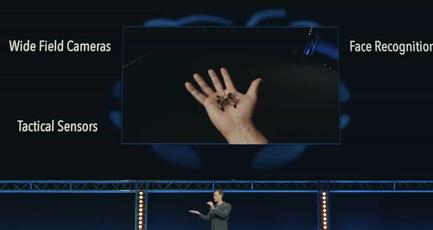
The Black Recon system comes with three drones, each of which “launches autonomously, performs reconnaissance, surveillance, and acquisition (RSTA) missions, then returns to the launcher for capture, docking, and recharging,” per a company announcement.
The drone, which weighs less than 450 grams (0.99 lbs.), has flight time of up to an hour and can hit a top speed of around 55 miles per hour, according to the company. The price of the system, and of the individual drones if replacements are needed, were not disclosed.
First flights of Black Recon happened in Norway last winter, and it’s been tested aboard a Ford Raptor vehicle, a company spokesperson told Breaking Defense. The spokesperson added the firm has signed contracts with two unnamed European customers; while the system has yet to be demonstrated for the US Army, the company expects to conduct trials with them later this year.
Deliveries should be available starting in 2027, the company said, with a pledge to add future modules to the system for both “lethality payloads and CBRN detection sensors.”
By bringing autonomous launch, recovery, and recharging directly to the vehicle, we give operators persistent situational awareness, faster access to actionable intelligence, and greater protection in high-tempo missions,” said JihFen Lei, president of Teledyne Defense and Aerospace Group and senior vice president of Teledyne Technologies, in the statement.
Editorial Analysis
The strategic significance of the Black Recon lies in its capacity to decentralize and democratize immediate tactical intelligence. By enabling vehicle-launched, autonomous RSTA, it directly addresses critical gaps in situational awareness, particularly for dismounted or vehicle-borne patrols operating in contested environments. This capability allows ground forces to gain crucial over-the-horizon or around-the-corner insights without necessitating external air support or dedicated drone operator teams, thereby significantly reducing response times and minimizing personnel exposure to direct threats. The sub-kilogram weight and hour-long flight endurance translate into flexible, rapid deployment for critical reconnaissance.
This system is a clear manifestation of the evolving battlefield, where smaller, more numerous autonomous systems provide a persistent, distributed sensor network. It reflects a trajectory seen in other domains, moving towards integrated, disposable or rapidly recyclable assets that enhance the sensor-to-shooter chain. As future modules promise both lethality and CBRN detection, the Black Recon also hints at a future where tactical assets blend ISR with localized strike or immediate threat assessment, raising important discussions about autonomy, target engagement, and proliferation risk.