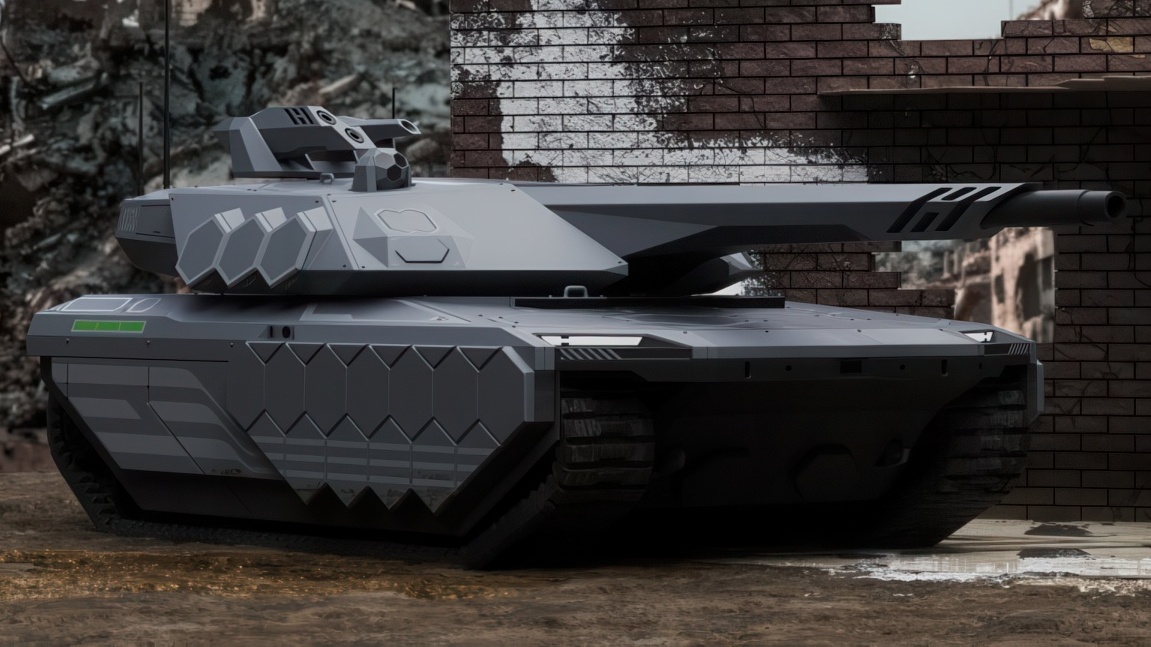
European defense manufacturers recently revealed two distinct next-generation main battle tank (MBT) prototypes at Eurosatory, signalling a significant modernization push for ground forces. KNDS and a Leonardo-Rheinmetall joint venture presented new designs aiming for operational readiness by the end of the decade, directly addressing evolving battlefield demands. This concerted effort highlights a critical pivot towards enhancing armored capabilities with advanced protection and networked features.
These unveilings underscore Europe's strategic imperative to refresh its conventional military strength, informed by contemporary conflict lessons. The emphasis on integrated counter-drone systems and digital architecture reflects a broader trend in defense innovation, preparing for future multi-domain warfare scenarios.
PARIS — European manufacturers have unveiled the latest iterations of two main battle tanks at Eurosatory, with the Franco-German group KNDS pitching a design for the French Army and Leonardo-Rheinmetall offering one for the Italian Army, both eyeing entry into service by 2030.
KNDS showcased its new CaPINT Maine Battle Tank for the first time on Monday, advertised as a gap-filler to replace France’s aging Leclerc fleet, which is expected to be retired around 2037.
The French national project was described by the manufacturers as designed to bolster French Army capabilities, with the vehicle to include increased firepower, counter-drone systems, an open digital architecture, and “connectivity with robotized wingers,” according to KNDS promotional materials, apparently a reference to unmanned ground or aerial systems.
The proposal is based on an upgraded KNDS Deutschland-manufactured chassis derived from the Leopard 2 A8 and features an unmanned Ascalon turret equipped with a 120 mm gun, like the Leopard 2 A-RC 3.0 MBT the company revealed at the show in 2024. The Franco-German defense group aims to deliver the first units of CaPINT the 2030s, according to a press release.
Another European firm presenting a new mock-up of its MBT at the show here is the Italian-German joint venture between Leonardo and Rheinmetall, Leonardo Rheinmetall Military Vehicles (LRMV), founded in 2024.
The vehicle, which is still under development, was displayed with a 30 mm remote-operated chain gun to defeat drones. This specific armament, the company said, is key to protecting the tank from high-angle drone strikes thanks to its 85-degree elevation.
LRMV is currently in negotiations with the Italian Ministry of Defense for the procurement of the MBT for the Italian Army, according to company representatives. They declined declined to comment on the stage of the talks, but said the firm is aiming for entry into service by the start of the decade.
Italian media have ly reported that Rome’s requirements would be for approximately 132 MBTs.
Beside the tank, at the show Leonardo set out a quadcopter-like drone to the Leonardo Vulcano 120 mm ammunition. This was done to envision a potential use case in which a laser-guided drone would be deployed to guide ammunition and enable it to shoot targets from farther away.
Editorial Analysis
The strategic importance of these next-generation MBT unveilings lies in their direct response to the evolving nature of ground combat, particularly the pervasive threat of unmanned aerial systems. The integration of high-angle 30mm chain guns and specific counter-drone systems, as seen in the Leonardo-Rheinmetall design, underscores a recognition that legacy armor alone is insufficient. Furthermore, KNDS's CaPINT, with its open digital architecture and connectivity with robotic partners, signifies a move towards truly networked and adaptable battlefield platforms capable of multi-domain operations. These capabilities aim to improve situational awareness, reduce crew exposure, and enable coordinated action with autonomous assets, fundamentally changing how ground forces will operate and defend.
This modernization drive is part of a larger European defense industrial renaissance, emphasizing collaborative development to achieve strategic autonomy and interoperability. The Franco-German and Italian-German partnerships highlight a trend towards integrated defense solutions that leverage shared expertise and resources. By prioritizing advanced protection, digital integration, and the capacity for joint operations with unmanned systems, these new MBTs are not merely incremental upgrades but foundational elements for a more resilient, adaptive, and technologically superior armored capability, crucial for deterring aggression and maintaining stability in a volatile geopolitical landscape.