WASHINGTON — The Army is accelerating development and increasing production of electromagnetic warfare and signals intelligence capabilities, according to information released as part of the service’s fiscal 2027 budget request.
“The pace of technology evolution is faster than the pace of traditional procurement processes, and this is particularly evident within the [electromagnetic spectrum operations] EMSO environment. We have reformed these processes and are now prioritizing investments in capabilities that will allow us to achieve spectrum dominance,” Portfolio Acquisition Executive for C2/Counter C2 Joseph Welch said.
Documents provided to Breaking Defense by the Army last week note the service is moving faster in FY27 to deliver EMSO capabilities to formations with an emphasis on providing relevant capability forward and learning from operational employment with greater solider input.
The documents note that the EW topline request increased from last year’s request, though they did not say by how much. The request to increase funding comes a year after Secretary of Defense Pete Hegseth directed the Army to achieve “electromagnetic … dominance by 2027” in the Army transformation and acquisition reform memo.
Despite no new start EW programs for FY27, the Army is accelerating division level electronic warfare capability, aligning EW companies more closely with intelligence and electronic warfare (IEW) battalion and using live events with learning demands to refine how electronic warfare is fought in formations. The budget furthermore supports increasing production to support IEW battalion transformation to two such battalions with advanced EW kit.
The Army has been on a nearly decade-long journey to modernize its EW enterprise, following divestment of much of its advanced capabilities after the Cold War. Russia’s incursion in Ukraine’s Crimea in 2014, served as a wake up call of sorts, according to Army officials and experts over the years. However, the service has struggled to deliver capabilities outside urgent operational needs systems, canceling, reevaluating or pivoting on systems years after prototypes, demonstrations and experimentation with units have occurred.
That also includes building new formations and learning how to fight EW at echelon.
Now, the service is aiming to flip its approach, opting for more commercially available capability that can be fielded rapidly as opposed to exquisite, bespoke systems designed against very ridged specifications. The Army noted that budget line item consolidation of EW systems, which began in FY26, allows for rapid prototyping to reveal commercial capabilities and reprioritized funding for faster fielding. This line item consolidation also allows distribution of capabilities based on unit mission, the Army said in written responses.
According to the Army, the FY27 EMSO investments don’t just focus on the urgent operational needs of today, but also set the conditions for the service’s broader EMSO modernization framework, that was codified in February’s Characteristics of Need statement.
Specific Systems
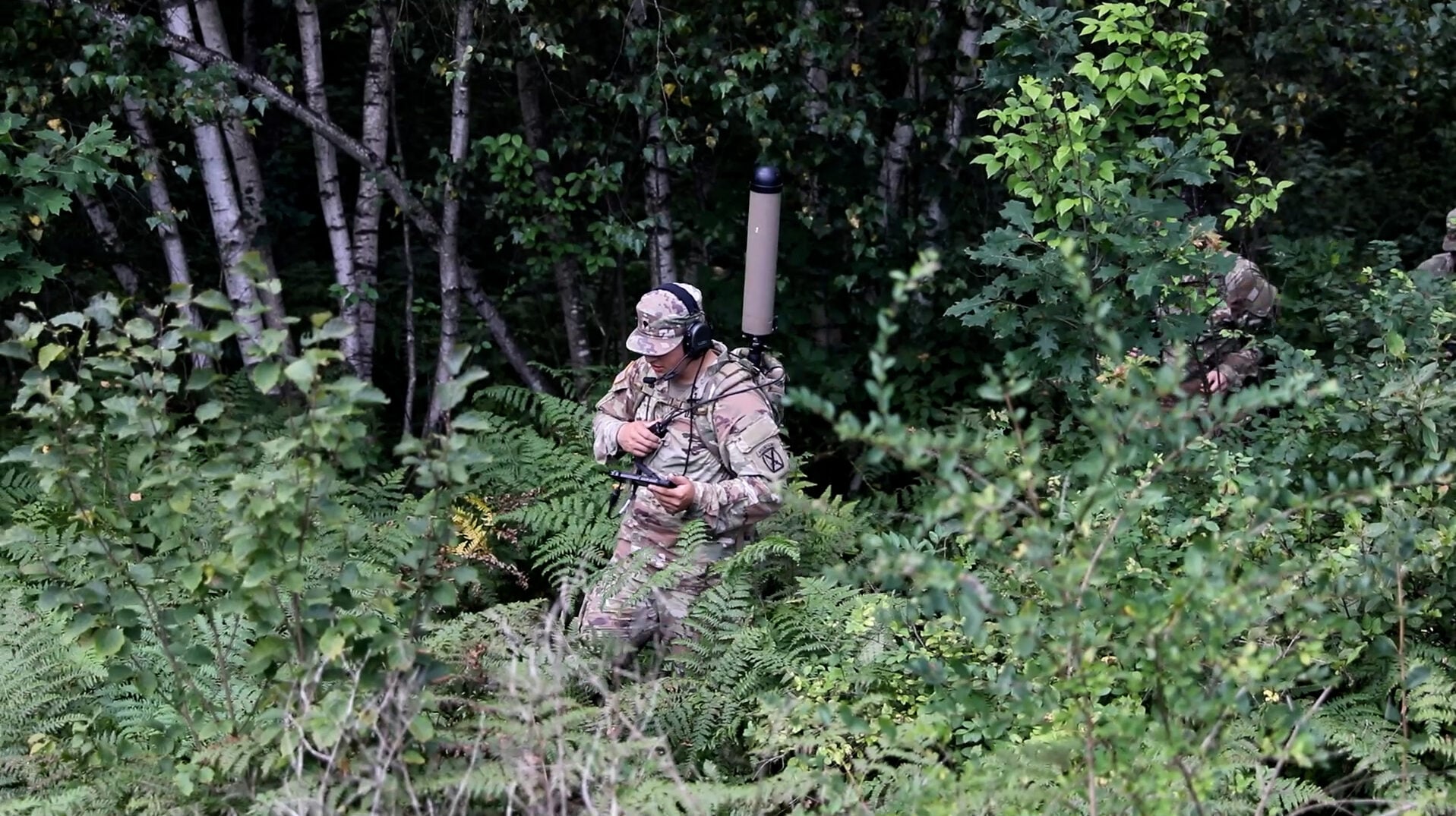
Aside from commercially available capabilities, when it comes to existing programs of record, the Army is requesting $76.1 million in procurement and $47.9 million in research and development funds for the Terrestrial Layer System (TLS) Manpack capability, a dismounted electronic attack system that soldiers can use for direction finding and limited jamming on the move.
The budget request allows the Army to “field up to 24 units [an] additional 159 Manpack Systems” and continue prototyping of the Modular Adaptor Kit (MAK).
The MAK is the answer to replace the TLS-Brigade Combat Team variant that was initially designed to be mounted on Strykers and then Armored Multi-Purpose Vehicles. The MAK can mount the Manpack to vehicles to provide the system with power and additional antennas for increased range and signal processing for advanced analytics.
Those MAK prototypes are being tested with Transformation in Contact 2.0 units with plans to build begin a production variant in fiscal year 2028, the Army said.
Further, there are plans in the budget request to procure TLS-BCT’s larger cousin, the TLS-Echelons Above Brigade (EAB). The Army requested $92.6 million in procurement and $66.9 million in research and development funds for the system.
The budget also requests $34.2 million in funding to procure up to 60 Spectrum Situational Awareness Systems, which will provide sensing and visualization of what units look like in the electromagnetic spectrum and allow commanders to sense and report in real-time their command post signatures.
When it comes to airborne EW, the Army is looking to acquire payloads in response to an urgent operational needs statement. Last summer, the service decided to move on from its program of record system, Multi-Function Electronic Warfare Air Large (MFEW-AL), a pod outfitted to MQ-1C Gray Eagle after over 10 years of development.
The service will monitor the performance of those payloads to determine which could serve as an enduring fit for identified unmanned aircraft systems. If one of those systems proves viable, the Army said, it could look to shift resources to enhance and produce it.