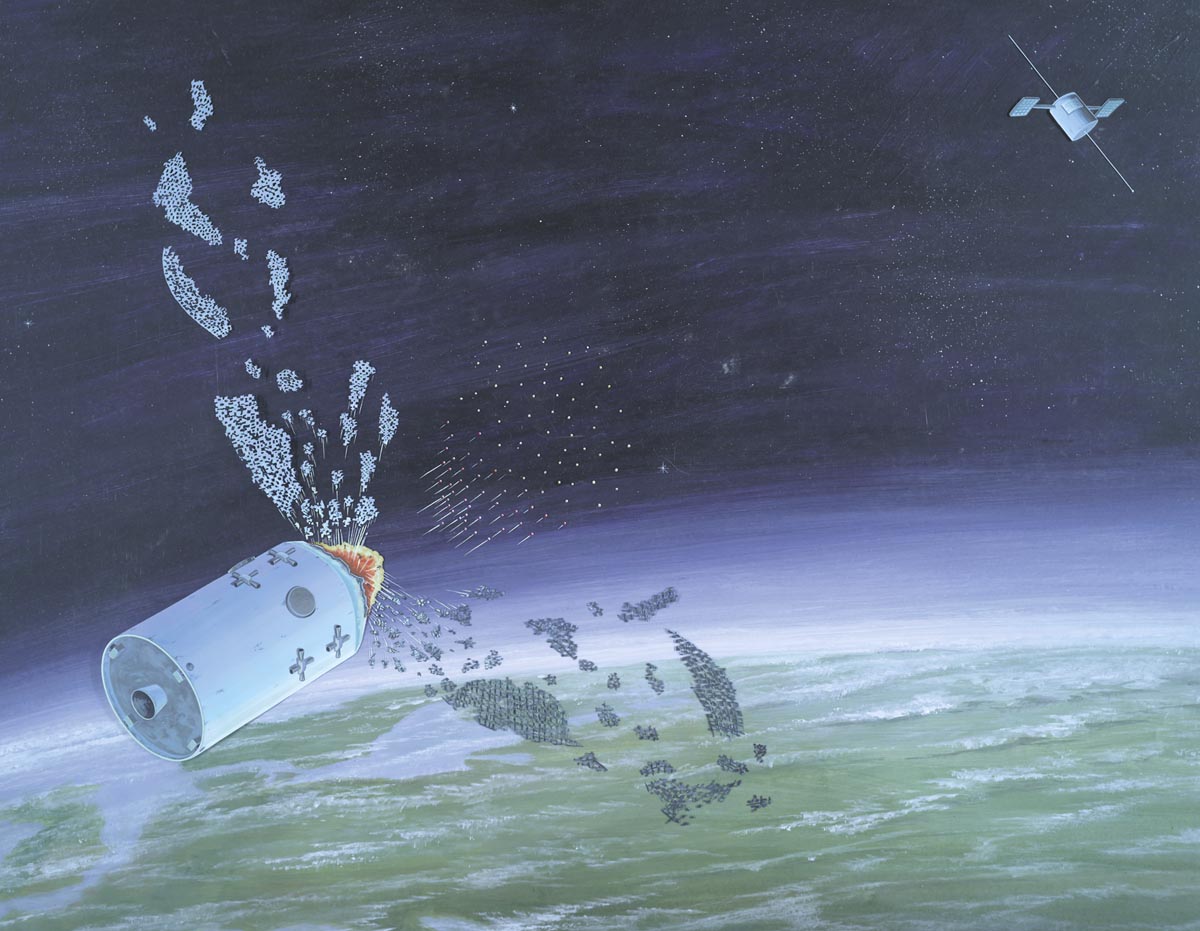
Occasional bursts of energy from a Russian missile-detection satellite have been briefly disrupting satellite navigation across large parts of Europe, a pattern that may indicate a “qualitative escalation in GNSS [global navigation satellite system] interference.”
At least 75 times between 2019 and 2026, University of Texas researchers observed 10-second bursts of high-powered radio signals at 1558.5 MHz: the frequency used by GPS and European navigation satellites to transmit signals to Earth. The bursts disrupted GPS antennas from Romania to Greenland, the researchers write in a paper published this month in the journal Navigation.
The origin of the pulses was a mystery. The vast size of the affected area ruled out ground- and even aircraft-based jammers, so the interference was coming from space.
Solar flares can disrupt satellite-location services, but unevenly. The disruptions were far more uniform.
“Clearly, the effects of solar radio bursts manifest differently in the IGS data compared to the transient phenomenon studied here,” they write.
The researchers created a mathematical formula for pinpointing the origin based on how intensely the radio signals hit different antennas across the affected area. The equation pointed to just one likely source: Russia’s Cosmos 2546 satellite. It was launched in May 2020, months after the first disruptions were detected, but it is part of the Edinaya Kosmicheskaya Sistema, a constellation of early missile warning satellites. They fly in the Molniya orbit, whose highly elliptical path keeps them over the high north for most of the time.
The researchers conclude that the radio bursts appear to be intentional, but too short to have any real effect. They offer no specific theory about Russia’s intentions.
But officials have become increasingly concerned about Russian space activity, including the possible orbiting of a nuclear weapon that could break GPS.
“It is unclear exactly what is happening, but it does appear to be a space-based jammer,” said Victoria Samson, the chief director of space security and stability at the Secure World Foundation. “I would guess that the reason why Russia is using its early-warning constellation for this is that it is at the right position and altitude to cover the area that Russia would want to interfere with GPS. It is possible that Russia was willing to risk using its early-warning constellation for this because it was fairly confident that the interference would not be detected; as it was, this has been going on since 2019 and was only discovered in the past several years."