WASHINGTON — The Army has laid out an ambitious goal to field the forthcoming Next Generation Command and Control (NGC2) architecture to all 11 divisions within a five-year window, according to a senior acquisition official.
“Another tenet of ours is we’ve got to get the entire network within that five year FYDP,” Brig. Gen. Shane Taylor said, referring to the Future Years Defense Program spending plan. “We are working very, very hard to get everybody in the Army within that window. And that window has traditionally been seven to 10 years.”
Taylor, Capability Program Executive for Capability Program Executive Command and Control Information Network (CPE C2IN), said that from his office’s perspective, the tight timeline means he’s got to “get creative within the capability window, within the solutions that we’re delivering.”
That means, he told the audience Tuesday at the AFCEA Belvoir Industry Days conference, “working with vendors, working with the prototype divisions on ways to be more efficient and effective at how we deliver those capabilities,”
Taylor clarified after his remarks to Breaking Defense that the goal is to field the Army’s 11 divisions in the five-year window, aiming to do two to three a year.
NGC2, one of the Army’s top priorities, is not a program of record, but a mix of capabilities to modernize how the Army shares battlefield data and communicates.
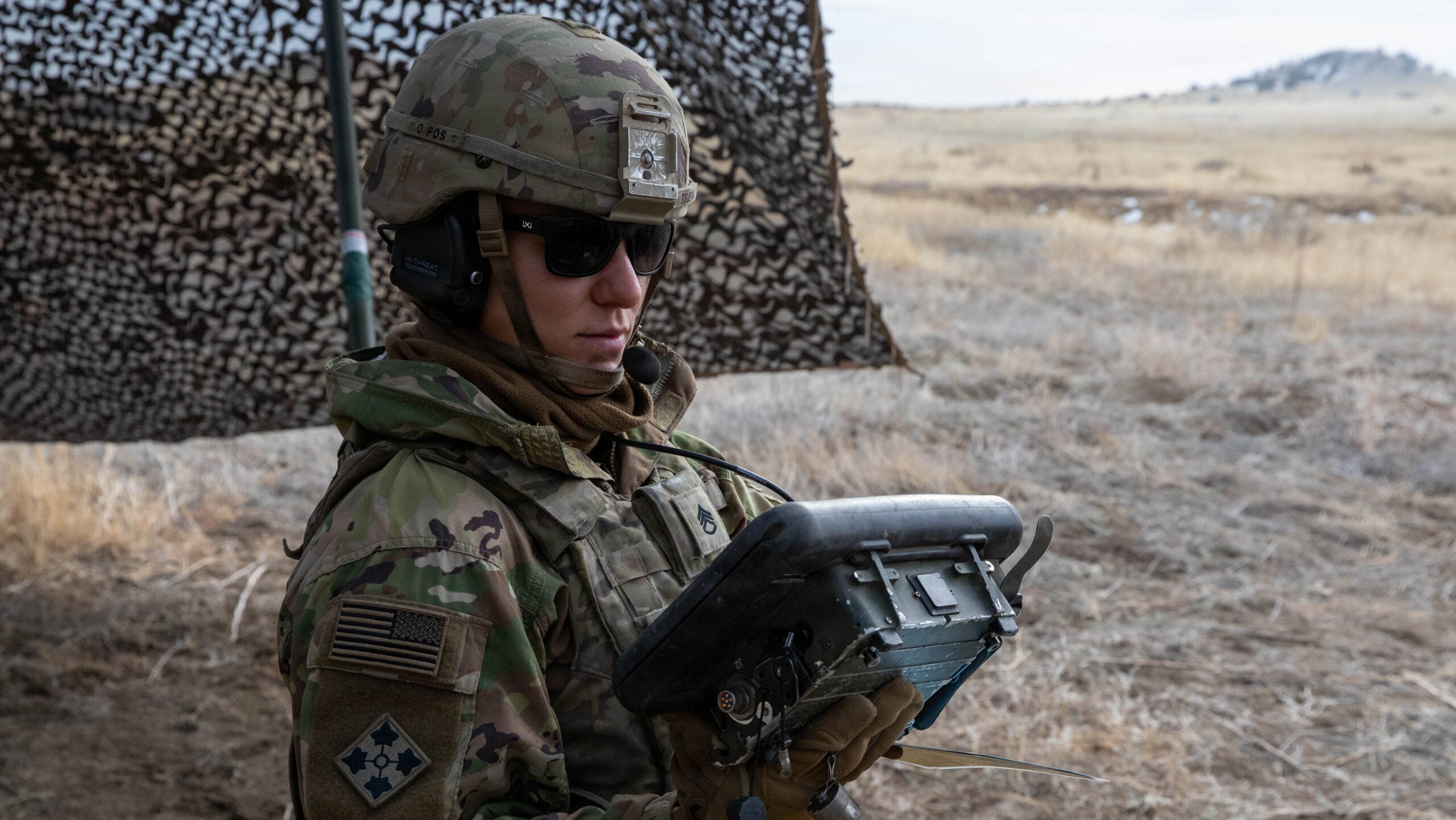
Taylor said that having not been “touched since the days of Force XXI,” a modernization effort in the mid-90s, the Army’s 4th Infantry Division is currently prototyping the NGC2 so-called full stack, which encompasses a transport layer, integration layer, data layer and application layer. The 25th Infantry Division is also prototyping NGC2 capabilities, albeit, the data layer, not the full stack — it had received a modernized network baseline in recent years called C2 Fix.
RELATED: Army and Marine Corps successfully shared fire mission data at recent exercise
Following those prototyping efforts this year, the Army plans to make a decision on a baseline of capabilities, for which Taylor acknowledged there is a mix of capabilities in the field and each division could look slightly different based on their region and formations.
Next year, the Army is focusing on I Corps to be the target formations as the service pivots to the Pacific.
“Those two prototype divisions are absolutely helping us get after what will be, what I’d call the normalized architecture that we’re going to pull out of those two divisions and carry forward to I Corps,” Taylor said. “We’re in those decisions, I mean, literally right now having some of those decisions, and you’ll start seeing some changes to those two prototypes as we cross pollinate between those two formations.”
Taylor said that the commercial-first approach the Army is adopting is poised to make the service flexible. The notion is that once the service gets through its five-year window, in year six it will start over with the first unit and repeat the cycle — but there will likely be new capabilities inserted into units during the five-year window when they become available.
The plan is to start delivering two division equipment formations year, Taylor said, and as they get into 2028, the Army will begin focusing on three divisions-a-year to get to 11 within the FYDP.
Taylor noted that following the prototype period, there won’t be a single delivery time.
“We’re moving to kind of a continuous delivery model. We’re in prototype right now with those two divisions. I wouldn’t use the word that we’re going to move in a production year. I would say we’re going to go into a continuous delivery model year,” he said.
That model, he said, is one of the biggest changes and, hopefully for the Army, the most impactful.
“As we go from formation to formation, we’re going to use that formation that we’re working with as we deliver kit, as their new capabilities come online, that would be the formation that we would prototype those solutions with,” he said. “You’re showing up and you’re delivering the Next Gen C2 ecosystem at the same time that as new technologies come within that year of execution, we’re going to use that formation to help us prototype that capability.”