MILAN — Ukrainian President Volodymyr Zelenskyy announced on Tuesday that the war-torn country will partially lift the ban on selling domestically-produced weapons abroad, but only to countries found to be non-cooperative with Russia.
In a long-awaited move, the Ukrainian leader said Kyiv willalter the current export rules, in order to still prioritize Ukraine’s domestic needs while allowing local companies to tap into a new funding stream by selling excess systems out of the country.
“Ukrainian companies will receive a real opportunity to enter partner countries’ markets, provided that our military has the right to receive the necessary volume of weapons first — only what companies can produce beyond the state order will be exported,” Zelenskyy said in a post on X.
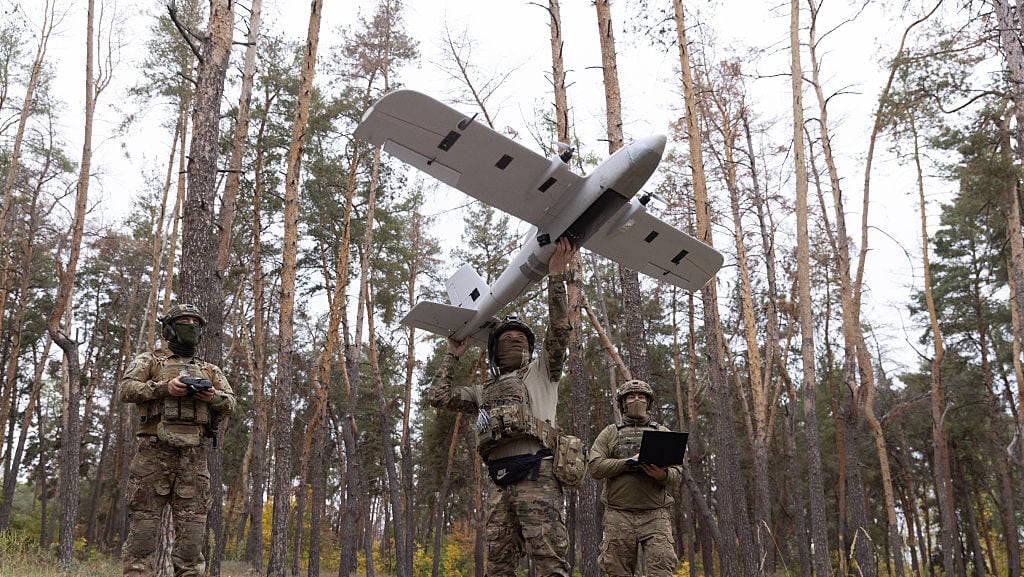
This will be done via so-called drone deals, which he qualified as special agreements enabling the production and supply of Ukrainian-made drones, missiles, ammunition, software, and other sought-after weapon types.
The embargo has been in place since the launch of Russia’s full-scale invasion in 2022, in an attempt to divert all weapons to the Ukrainian Armed Forces.
Ukrainian companies have been pushing for several years to ease that embargo, saying it has restricted their ability to bring in capital from other countries — money, they argue, that would help them invest to increase production and develop new technologies which would, in turn, benefit the defense of their homeland.
Back in September, Ukrainian officialsfloated the idea of opening up exports and cooperation with countries that are part of the Joint Expeditionary Force — a UK-led coalition of 10 countries, including Norway, Estonia, Finland, Iceland, Lithuania, Latvia, Sweden, the Netherlands, and Denmark.
At the time, in an interview with Ukrainian media outlet United24, a representative from Brave1, a government-supported defense technology hub, identified naval drones, drone navigation software, turrets and unmanned ground vehicles as export-ready arms categories.
One of the main challenges of facilitating exports to the global market is the risk that key systems fall into the hands of Moscow.
Under the new format, Zelenskyy noted that the country’s Ministry of Foreign Affairs, in cooperation with intelligence services, will be responsible for determining the list of states to which the export of military technologies is prohibited due to their cooperation with Russia.