Bellingcat has identified several high-profile incidents where authorities in the United Arab Emirates have downplayed damage, mischaracterised interceptions and in some instances not acknowledged successful Iranian drone strikes on the country.
A review of official statements shows that the public account does not always align with what can be observed through open sources. This comes as the UAE faces sustained aerial attacks on civilian and economic infrastructure, challenging its image as a secure global hub for business and tourism. Hours after the United States and Israel launched coordinated attacks on Iran on Feb. 28, the Islamic Republic responded by launching an attack against US-allies in the region including the UAE.
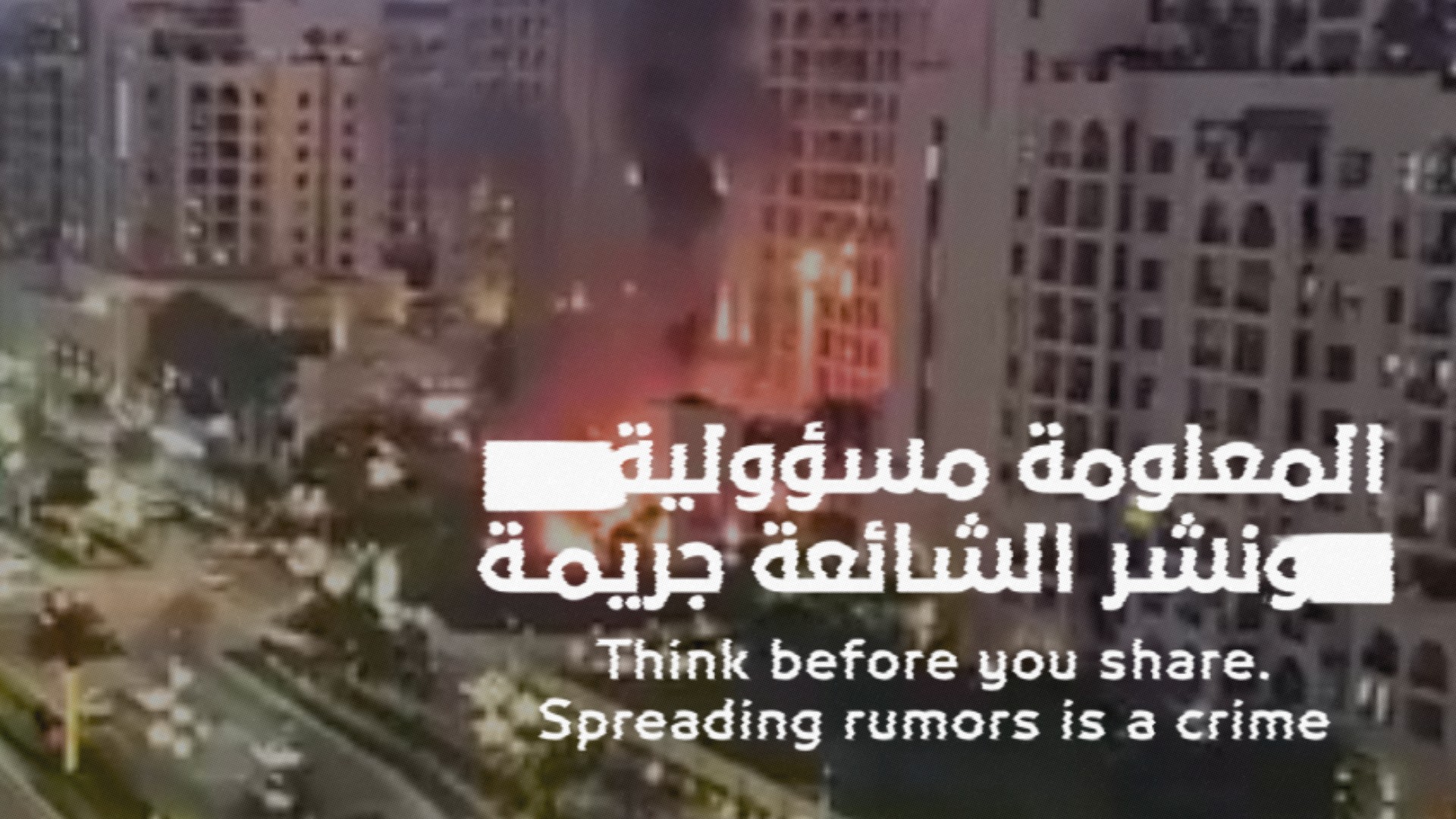
In the wake of the attacks, the UAE’s attorney general warned that publication of images or videos of strikes was illegal. People were also encouraged to report anyone sharing photos or videos of the strikes to authorities.
The country’s attorney general has ordered the arrest of 35 people and said they would face an expedited trial for “publishing video clips on social media platforms containing misleading, fabricated content and content that harmed defence measures and glorified acts of military aggression against UAE.” Separately police in Abu Dhabi reported they had arrested just over 100 people on suspicion of filming incidents related to Iran’s attacks on the UAE and sharing misleading information online.
Bellingcat contacted the Dubai Media Office, the Fujairah Media Office as well as the UAE’s Ministry of Defence to understand how statements are put out and how distinctions are made between successful drone strikes and damage caused by debris. We did not receive a response by the time of publication.
“Spreading Rumours is a Crime”
During the first days of the conflict several videos were posted on social media, primarily on X, TikTok and Telegram showing footage of Iranian attacks and interceptions across the UAE.
Around the same time the Dubai Media Office, the X account of the Government of Dubai’s press office, warned followers that legal action would be taken against those sharing “unverified material”.
The X account of the Dubai Media Office has more than 2.3 million followers making it one of the largest state-run accounts in the country.
“The public and media are urged to rely solely on official sources for accurate information and refrain from sharing unverified material,” the account posted.
Dubai Police issued similar warnings on social media, stating that sharing content that contradicts official announcements could lead to imprisonment of at least two years and fines of no less than 200,000 dirhams (approximately $55,000).
Despite authorities urging the public to rely on official sources only, Bellingcat found that some of the videos posted online as well as satellite imagery from the region contradicts a number of official accounts of high-profile attacks. For this piece we have only included links to videos that have already been widely published in mainstream news outlets, posted by professional journalists, or have been widely viewed on social media.
Successful Interceptions?
On March 3, a video filmed from a vessel appears to show a drone striking the port of Fujairah, one of the UAE’s most strategically important energy hubs. The port handles roughly 1.7 million barrels of oil per day and is among the world’s largest.
The drone appears to approach its target intact, with no visible sign of interception, Sam Lair, a researcher at James Martin Center for Nonproliferation Studies, told Bellingcat.
Moments after it descends behind storage tanks, an explosion is heard and a large plume of smoke rises from the site.
On the same day, the Fujairah Media Office stated that a fire resulted from debris following a successful interception, adding that the fire had been brought under control. Satellite images captured on March 4 and 5 show thick black smoke rising from the site. NASA FIRMS data also detected fires on March 3, March 4 and March 5. By March 7, satellite imagery shows at least three storage tanks fully destroyed (25.184565, 56.345481).
Detained in Dubai, a group that provides legal advice to people detained in the UAE, said that a Vietnamese national who filmed the strike on Fujairah port had been detained by authorities after posting the footage online.
Authorities made a similar report on March 1, stating that a fire at one of the berths of Jebel Ali Port was caused by debris from an aerial interception. Satellite imagery from the same day shows fires at two separate locations – approximately 3 km apart – within the port. One appears to be a central facility associated with fuel handling operations, connected via pipelines to surrounding storage tanks (25.00704, 55.07499). The other is a large structure (24.97953, 55.05204) in the military area of the port, which is one of the US Navy’s busiest ports in the Middle East. The New York Times previously identified an Iranian strike as the cause of the fire at the site.
Burj Al Arab: A “Limited” Fire
Damage at Dubai’s Burj Al Arab Hotel was attributed by the Dubai Media Office to “shrapnel” from an intercepted drone and described as a “limited” fire. However, footage shows the fire extended to approximately 30 metres in height, covering approximately eight floors of the building, suggesting a far more significant incident than officially described.
Lair told Bellingcat that the damage appeared more consistent with a direct impact. He added that if the damage had resulted from an interception it would have occurred irresponsibly close to the building.
Fairmont The Palm: Omission of Cause
On Feb. 28, the Fairmont hotel in Dubai’s Palm Jumeirah area was struck by a drone, as shown in footage verified by Bellingcat.
However the Dubai Media office did not confirm a strike took place, instead they stated only that an “incident occurred in a building in the Palm Jumeirah area,” and urged the public not to share footage.
One video of the fire was shared by a Dubai-based Bloomberg journalist. In the replies to the journalist’s post, multiple users tagged the Dubai Police, a pattern seen across posts documenting the strikes, in an apparent effort to flag violations of the cyber-crime laws to authorities.
The aftermath of the strike was also captured by a content-creator who has since left the UAE.
Radha Stirling, founder of Detained in Dubai, told Bellingcat at least five people have been confirmed by the British embassy to have been charged and detained under the UAE’s cybercrime law in connection with documenting this strike. According to Stirling, authorities have sought access to individuals’ phones following incidents to determine whether they filmed or shared footage.
“Even just taking a photo is illegal, it’s illegal to share content that the government deems negative, even in a private message,” Stirling said.
Dubai International Airport: An Unacknowledged Strike
On March 7, the Dubai Media Office announced the temporary suspension of operations at Dubai International Airport, stating only that a situation was being handled under safety protocols.
Footage that emerged online around the same time, and was verified by Bellingcat, shows a drone strike next to an airport terminal building (25.24165, 55.37498).
Stirling told Bellingcat that she has been in contact with a cabin crew member who was detained after sending an image to colleagues of Dubai airport after an explosion.
Warda Complex: A Direct Hit
On March 1, a drone struck a residential apartment on the 19th floor of the Warda complex in Dubai (25.004320, 55.293164). Two videos filmed from different angles show the drone hitting the building directly, with no visible sign of interception. In one clip, filmed inside the apartment, a British resident says: “We’ve just been hit by a drone… I didn’t even finish my cup of tea.”
The footage shows relatively limited damag