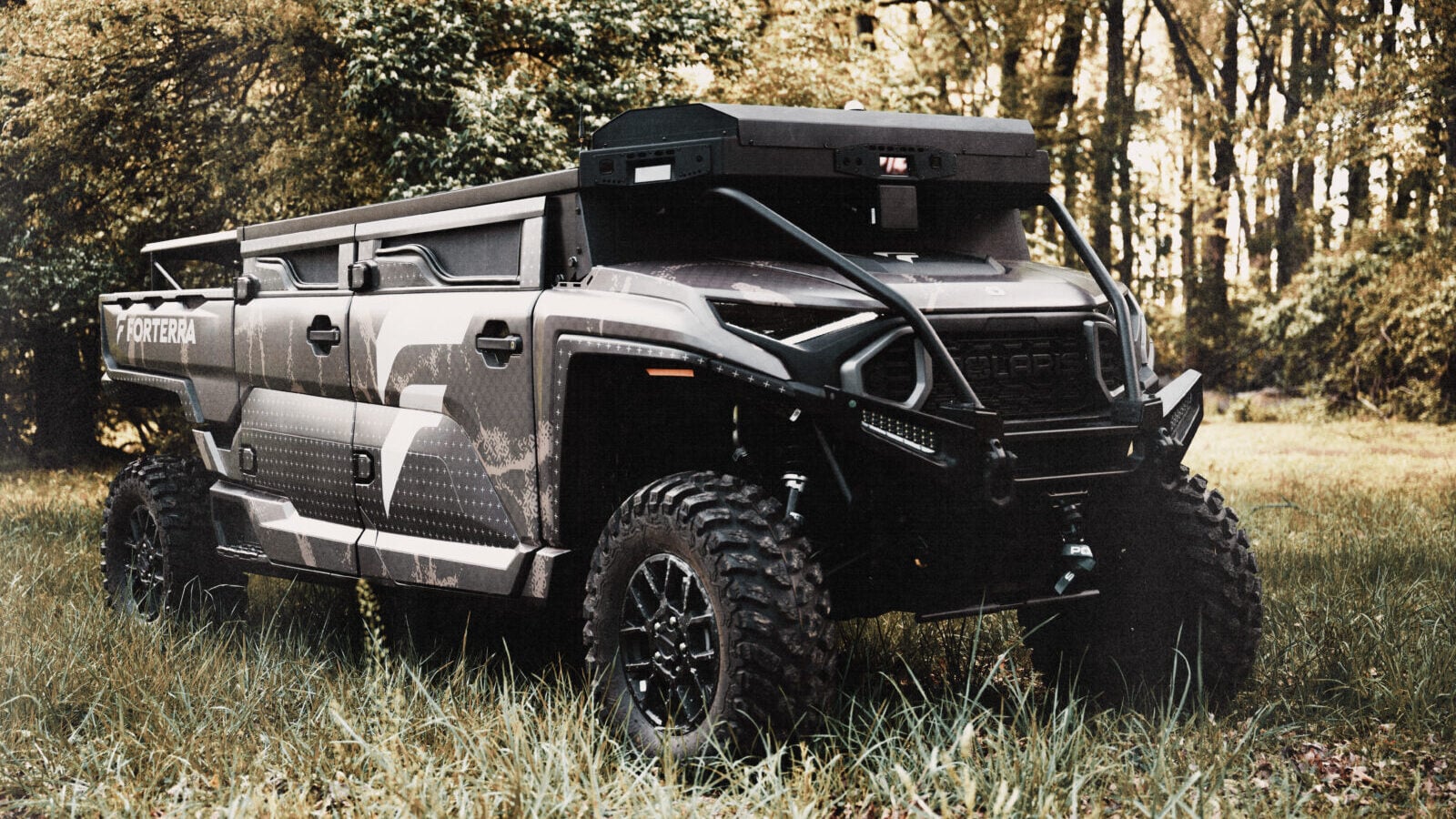
WASHINGTON — Autonomy developer Forterra and vehicle manufacturer Polaris announced today a new vehicle, dubbed MESA, designed for casualty evacuation (CASEVAC) and logistics missions.
The platform, unveiled today at the annual Modern Day Marine expo, is based on a modified Polaris Ranger XD 1500 and uses Forterra’s AutoDrive autonomy stack and the company’s Vektor communications capability designed to work in low-bandwidth environments, the companies said in a release today.
“Because MESA is built in direct partnership with Polaris, every vehicle comes off the same market-leading production line that delivers Polaris platforms globally, with all modifications executed alongside the OEM [original equipment manufacturer.] This results in a more robust, fully integrated platform without aftermarket changes to the base vehicle chassis,” Pat Acox, Vice President of Defense Growth at Forterra said in the release.
The companies said the vehicle has L-track mounting and a flat deck design, allowing for interchangeable payloads of up to 2,000 lbs. John LaFata, engineering manager at Polaris, said in the release that the Ranger XD 1500 is also designed to operate in “extreme terrain.”
The companies said the vehicle would be key for operations in the “last tactical mile” — the treacherous area between support units and the forward lines where supplies, equipment and personnel must be moved while often facing risky adversarail encounters.
The Marine Corps has shown interest in unmanned ground vehicles, and the announcement comes about two weeks after the Army’s Mission Autonomy Capability Program Executive office published a call to industry looking for autonomous vehicles capable of last tactical mile CASEVAC missions and logistics operations.
“This advanced UGV [unmanned ground vehicle], owned by maneuver formations, will both sustain Platoon and Company formations by delivering essential supplies/energy and will evacuate wounded personnel from the point of injury to a casualty collection point,” the Commercial Solutions Opening reads. “This dual use UGV shall feature a configurable payload to meet the dynamic needs of maneuver formations.”
Forterra nor Polaris responded to a request asking if the companies intended to respond to the Army CSO by press time.
Forterra’s AutoDrive is currently integrated into Marine-owned Joint Light Tactical Vehicles for the service’s Remotely Operated Ground Unit for Expeditionary (ROGUE) Fires program. It’s also integrated into BAE Systems’ Armored Multi-Purpose Vehicle for an experimental autonomous AMPV prototype, and Forterra was set to incorporate the stack into the Army’s now paused ISV unmanned program, otherwise known as UxS.
“By combining field proven autonomy with secure, software defined communication capabilities, the MESA enables forces to deploy coordinated, adaptive impact across a wide range of missions without increasing additional risk to the warfighter,” today’s release read.