WASHINGTON — The Marines Corps will start development for the second increment of its Advanced Reconnaissance Vehicle (ARV) program at the end of this decade, one senior official said today, while revealing new details on what Increment 2 will entail.
“We’re always working our requirements because it’s a fast-moving conversation, but we don’t plan to really start Increment 2 development until [20]29, and so that will run in parallel as we make the production down-select and work on our initial fieldings for Increment 1,” Col. Christopher Stephenson, the Marine Corps’ program manager of Vehicle Systems, said today at the annual Modern Day Marine exposition.
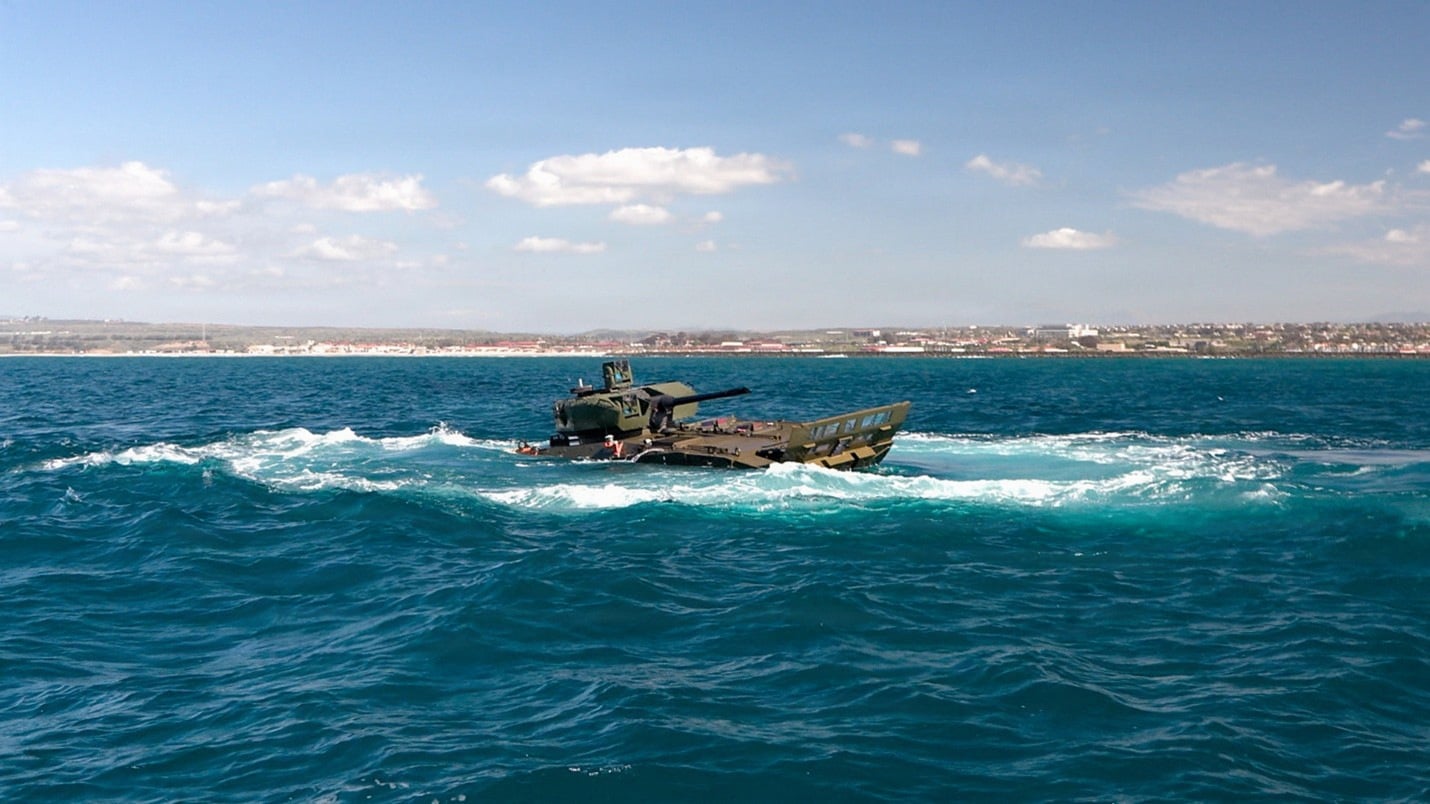
Increment 1 of the ARV program is currently in the pre-production development stage, withGeneral Dynamics Land Systems (GDLS) and Textron on contract to deliver 16 vehicles each to the Marines by 2028. A down-select decision for the first increment is scheduled for 2029, and a production award will be made in late 2030, Stephenson said.
The two companies are responsible for producing three vehicle variants for the first increment: a command, control, communications and computers-unmanned aerial system (C4/UAS) model, a logistics model and a model with a 30-mm autocannon.
Related: Marine Corps awards Textron, General Dynamics second rapid ARV prototype contract
Stephenson revealed today that Increment 2 will consist of a counter unmanned aerial system (c-UAS) variant, a recovery variant and one for precision fires. According to a slide deck shared with the audience, the Marines hope to find a c-UAS model that provides kinetic and non-kinetic capabilities. Further it should be “optimized” for a 24-hour c-UAS threat while also able to “detect and engage ground threats as well.”
Not many details for the recovery variant were revealed, but the slides noted that the “design driver for this variant is the crane and winch,” adding that the capability should have a fuel foraging system and a metal wielding and cutting capability. The slides further indicated that the precision fires model should provide beyond-line-of-sight fire support to formations out to 40 kilometers and be equipped with reconnaissance, electronic attack and surface attack capabilities.
Stephenson disclosed today that the Marines plan on acquiring a total of 654 ARVs — 426 for Increment 1 and 228 for Increment 2 — though these numbers may change as the service is constantly adjusting its priorities to fall in line with the current threat environment. Stephenson said it is not yet known when any awards for Increment 2 will be decided.
“If you actually lay out Increment 1 and Increment 2 production, we will be building these vehicles for 10 years. So there’s plenty of opportunity for adjustments and requirement changes, again, to keep pace with the threat, but also just the reality of whatever may change. The experimentation that’s inherently part of force design, as I always say, is a journey. Things are going to change,” Stephenson said.