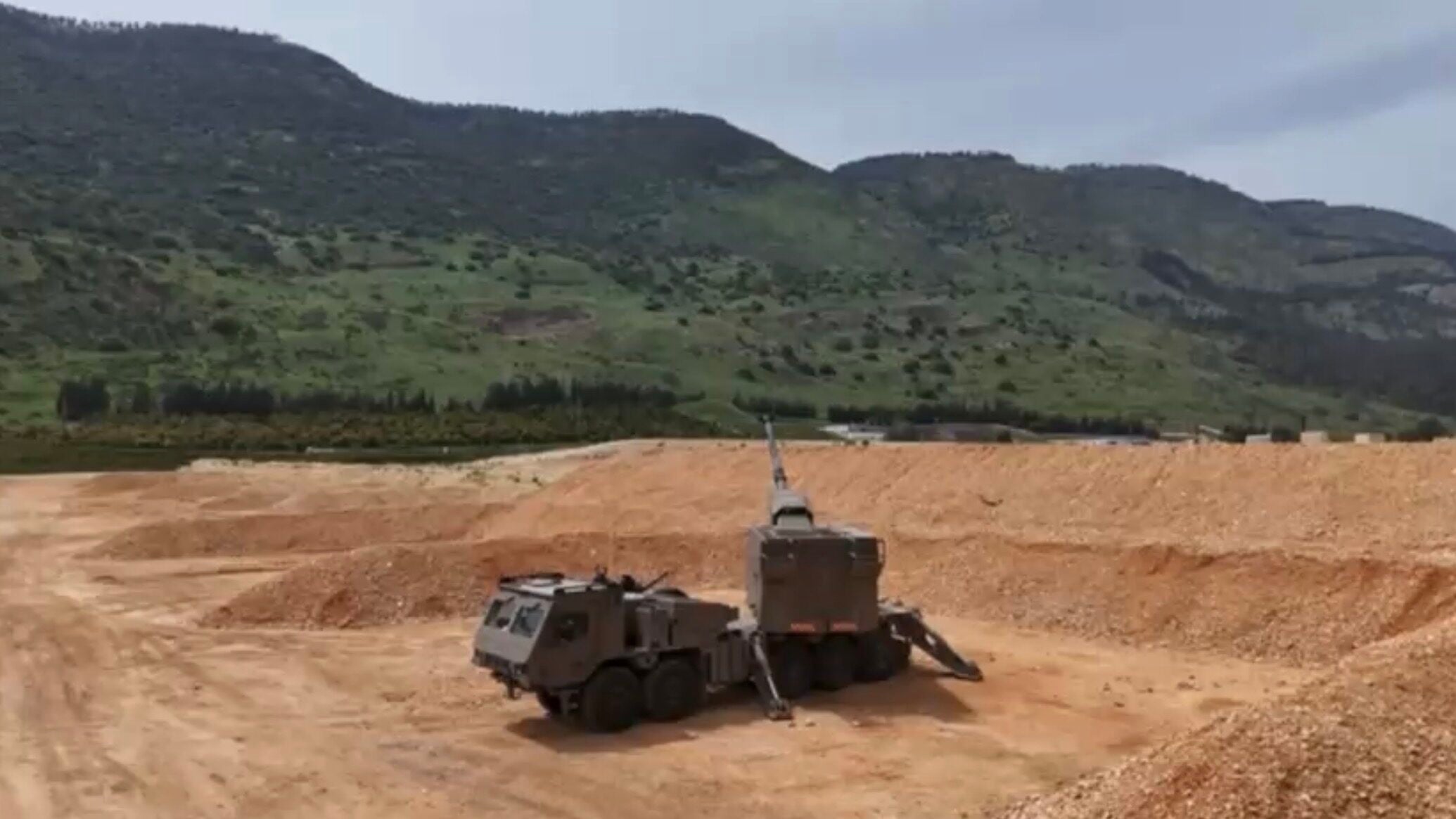
JERUSALEM — The Israel Defense Forces conducted the first operational firing of the new self-propelled Roem howitzer during operations in Lebanon, the IDF announced in a statement.
The new artillery system is fully automatic and capable of firing at a rate of 6-8 rounds per minute, up to 40km in distance. The first deployment of the weapon, which Elbit Systems began developing in 2019, occurred with the IDF’s 282nd Fire Brigade after several years of anticipation.
The unit “activated the new system in recent days in assistance to the forces maneuvering in the north, and used it to attack Hezbollah targets from which fire was fired at our forces,” according to an IDF statement in Hebrew.
“The Roem brings with it a lot of new capabilities compared to the existing cannon,” the IDF’s Lt. Col. B., the head of the Roem branch in the IDF, said in the statement. (The officer’s full name was withheld for security reasons.) He said the new capability was a change in “both mobility, full automation, and the ability to operate as part of a maneuver deep in enemy territory. It shoots farther and more accurately.”
In a statement, Bezhalel Machlis, President and CEO of Elbit Systems, called the deployment a “milestone.” He added that “the Artillery Corps is in the midst of a groundbreaking technological revolution, and for us, as a leading Israeli defense company, we are proud to play a significant role in realizing the commanders’ vision.”
The automated howitzer, which uses a 155mm shell, is wheeled and mounted on a 10 by 10 chassis so it can maneuver quickly and in a variety of terrain. A statement from Elbit Systems notes that it has the capability to conduct firing in Multiple Rounds Simultaneous Impact (MRSI) capability — a concept where several shells can be fired in different trajectories and hit a target at the same time.
The Roem provides a couple of benefits over the legacy M109 howitzers. It can be deployed with what the IDF says is more agility and accuracy. The higher rate of fire also means that fewer guns are needed for each battery, compared to the aging M109s. In an IDF M109, the crew would be involved in manually moving the 155mm shells and placing them and the propellant charges in the gun, preparing the fuze as well as dealing with communications and targeting. With the Roem, that’s now an automated loading process.
As a result of all that, the IDF says that “response” time for the system to be ready to fire is less than a minute and “operating the weapon requires only three crew members – compared to eight” for the M109. The IDF also says the system can operate without a driver and this appears to give it remote-operation capability. Israel’s CTech has described it as being “AI-powered,” although how AI has been incorporated was not specified by the IDF or Elbit.
The new system is expected to be integrated into the IDF’s artillery units, both reserve and regular units.
The deployment of Roem is part of a wider modernization across the IDF. This includes the acquisition of new refuelers, drones, helicopters, warplanes and helicopters for the Air Force. In addition, it includes the deployment of a number of new systems for the ground forces, including loitering munitions and robotic vehicles. In the air defense realm, the IDF is also deploying new laser air defenses.