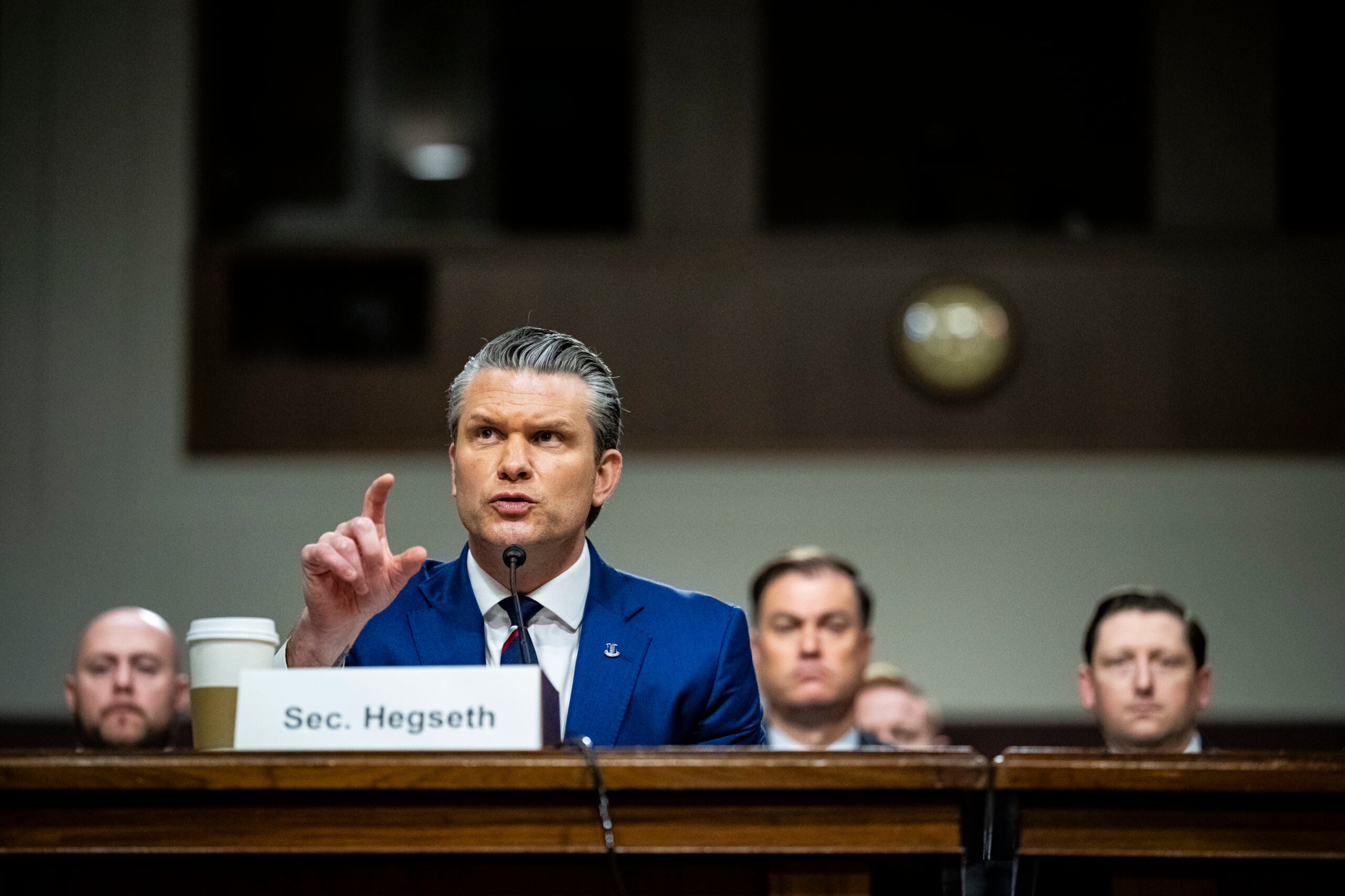
WASHINGTON — Ten months after Congress passed its reconciliation effort, only $26 billion of the roughly $152 billion earmarked for defense has been placed on contract, Defense Secretary Pete Hegseth said today.
However, Hegseth told members of the Senate Armed Services Committee that the money is set to start flowing soon, saying, “we’ve got the floodgates about to open and apply to those priorities.”
Formally known as the One Big Beautiful Bill, the sprawling megabill included additional multi-year funding for an array of defense initiatives including Golden Dome, two Arleigh Burke-class destroyers, munitions, nuclear modernization and more. Although that legislation dictates broad contours for how money is spent, not all of the defense spending in that bill is tied to specific weapons programs — giving the Pentagon latitude for how it executed the funding.
Republicans have been eager to see cash flowing to key technologies, but the process has been slow, with the Pentagon only submitting its spending plan to Capitol Hill in February.SASC Chairman Sen. Roger Wicker, R-Miss., put the blame on the Office of Management and Budget (OMB) for the delayed start on inking contracts.
“Unfortunately, you’re starting a bit late, through no fault of your own, because the money was not sent timely by the Office of Management and Budget to the department until last month,” Rogers said.
Last year’s approved reconciliation pot is not a one-off, as the Trump administration is eyeing a second round during the fiscal 2027 budgeting process. As part of its $1.5 billion request to fund the Pentagon year it has outlined plans for $1.15 trillion inside the base budget with an additional $350 billion coming from a proposed reconciliation bill.
Planning that funding in such a way may prove to be a risky endeavor.
House and Senate GOP leaders are currently focused on passing a narrowly-tailored reconciliation bill with funding to keep immigration enforcement agencies operational throughout the rest of the Trump administration, meaning defense funding would have to come in a second reconciliation bill. It’s unknown if Republicans, in what is shaping up to be a tight political environment, can summon the political will to get that second reconciliation across the finish line.
Across several hearings today, lawmakers from both sides of the aisle questioned the department’s strategy of relying on reconciliation to fund so many critical funding needs, such as munitions and Golden Dome.
“All those items of housing or Golden Dome, whatever — why aren’t they in the regular budget?” asked Sen. Angus King, I-Maine, during the SASC hearing. “Why do we suddenly have a two part budget where this committee and the Congress generally has oversight and input, to a process where a corner of the budget is essentially a slush fund?”
In an earlier House Appropriations defense subcommittee hearing, its chairman Rep. Ken Calvert, R-Calif., told Air Force and Space Force leaders that they should put their “priority needs either in the base budget or the supplemental,” rather than reconciliation, to ensure they receive stable funding.
Speaking to reporters following the SASC hearing, Wicker said that given the current congressional schedule, it’s possible defense reconciliation could only be passed following the midterm elections.
“I wouldn’t be surprised if it’s enacted after the election. I am quite hopeful that it will indeed be enacted sometime in November,” he said.
Iran Supplement Up Next?
On top of the $1.5 trillion in planned spending, the Pentagon has also been eyeing a potential supplemental funding request to cover costs associated with the war in Iran.
Hegseth, Chairman of the Joint Chiefs of Staff Gen. Dan Caine and Jules “Jay” Hurst, who is performing the duties of the Pentagon comptroller, told members of the House Armed Services Committee on Wednesday that such a request will come later once the costs of Iranian operations become more clear.
Hurst stated at that House hearing that the current price tag hovers around the $25 billion mark and said, “Most of that is munitions…Part of that [is] obviously O&M [operations and maintenance] and equipment replacement.”
Today, Sen. Richard Blumenthal, D-Conn., pressed him on if that figure included the costs of repairing bases and replacing equipment, saying it seems “well below” the actual cost based on everything available to lawmakers.
Hurst avoided specifically saying if funding for construction was included in the cost, instead noting that the figure for repairs could change depending on a variety of factors.
“For the MILCON [military construction] facilities replacement cost, that’s probably the hardest thing to estimate right now, because we don’t know what our future posture is going to be, or the future construction of those bases,” he said.
Those comments mirror ones he made earlier this month during a press conference where he said the US “might change how we build bases in the Middle East based on this conflict.”
Michael Marrow in Washington contributed to this report.