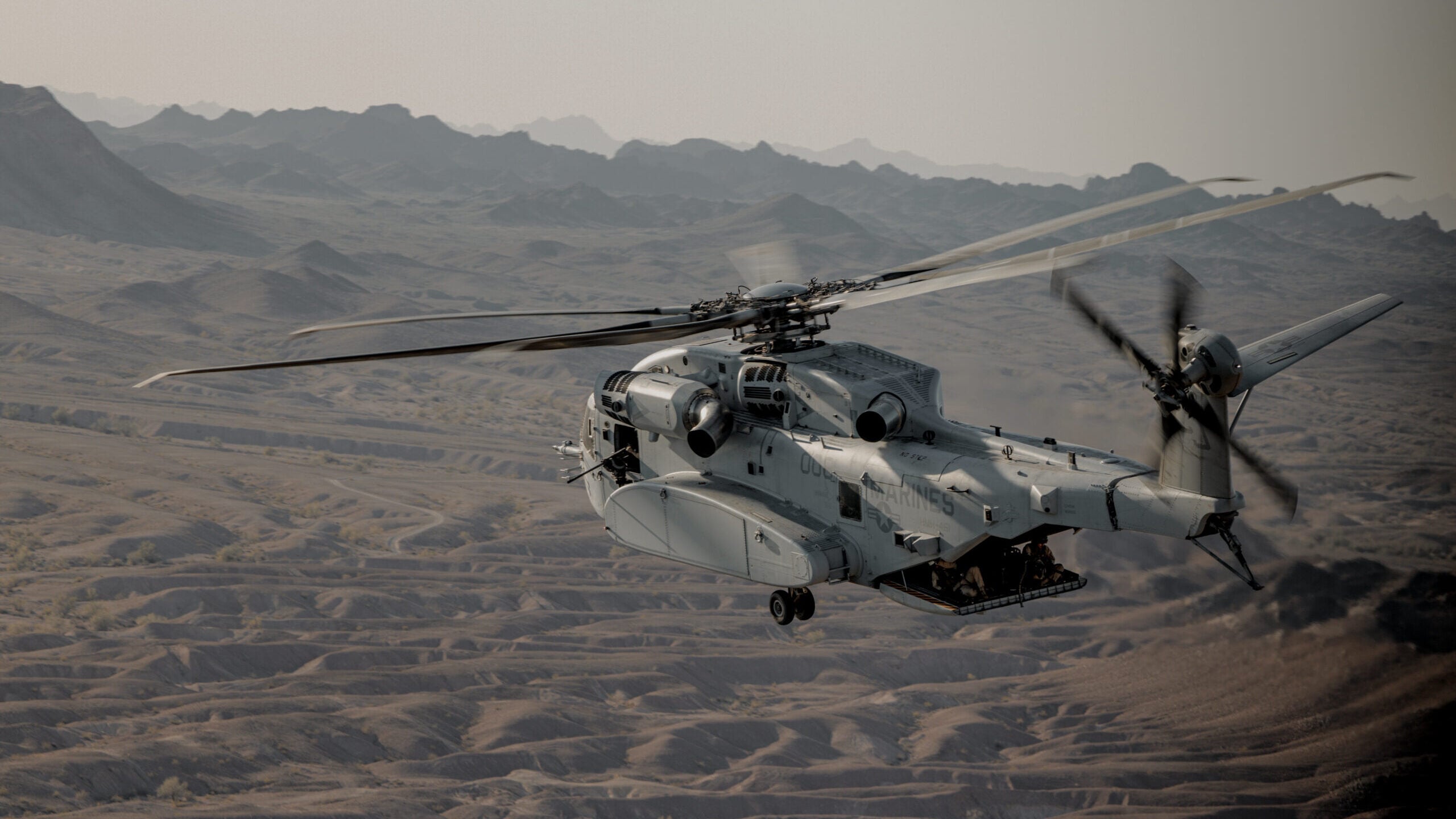
WASHINGTON — The Marine Corps’ new heavy-lift helicopter is slated to kick off its first operational deployment with the 26th Marine Expeditionary Unit (MEU) in fiscal 2027 after several delays, the program’s manager said.
The CH-53K King Stallion just reached 10,000 fleet flight hours while conducting shipboard evolutions as it gears up for the upcoming deployment, Col. Kate Fleeger said.
“The Marine Corps has a very deliberate plan for not only training, but also personnel and additional preparation for that deployment,” Fleeger said at the Modern Day Marine exposition. “So we are deliberately moving through those individual checklist items to get ready and are continuing to progress towards that 26th MEU deployment.”
Although the Marine Corps ly said in 2022 that the helicopter would conduct its first operational deployment in FY24, that date has been pushed back several times to accommodate the “production of additional aircraft and spare parts, and for the maturation of the broader supply network,” according to Marine Corps spokesperson Capt. Jacob Sugg. As a result, Sugg said the deployment was postponed “to mitigate operational risks and ensure the smoothest possible transition of this capability to the warfighter.”
“This proactive approach was designed to ensure the success of the first and all follow-on deployments while simultaneously supporting stateside units and the production line,” Sugg said in a statement to Breaking Defense.
The service said in its 2026 aviation plan released in February that the aircraft would deploy in FY27, but did not disclose details regarding the unit the helicopter would deploy with. The 26th MEU is based out of Camp Lejeune in North Carolina.
The King Stallion has the capacity to lift three times the load of the CH-53E Super Stallion that it’s replacing, according to Lockheed Martin. The helicopter, with the increased payload capacity, is designed to carry cargo like armored vehicles and troops, and has successfully completed an air-to-air refueling test, according to the company.
Sikorsky, a Lockheed Martin subsidiary, manufactures the aircraft, and said in September that it had delivered 20 aircraft to the service. As of Wednesday, Fleeger said that the Marine Corps now has 25 King Stallion aircraft in its fleet. Altogether, the Marine Corps is seeking to acquire 200 aircraft for the program.
The Marine Corps has touted that the helicopter and its capabilities are a gamechanger as it seeks to implement its distributed aviation operations strategy, which requires dispersing aviation assets in an attempt to bolster survivability and complicate adversary targeting, according to the Marine Corps’ 2026 aviation plan.
“Now, given the payload amplification of the ’53K, plus its range without having to tank off of a high value asset, like a C-130 or other aerial refueling assets within the department, it gives it its ability to do these missions very independently and provide a lot of sustainment capability to the forces without having to rely so much on a fuel source,” Lt. Col. Marianne Carlson, aviation vision and strategy planner at Marine Corps Aviation Headquarters, told Breaking Defense in March.