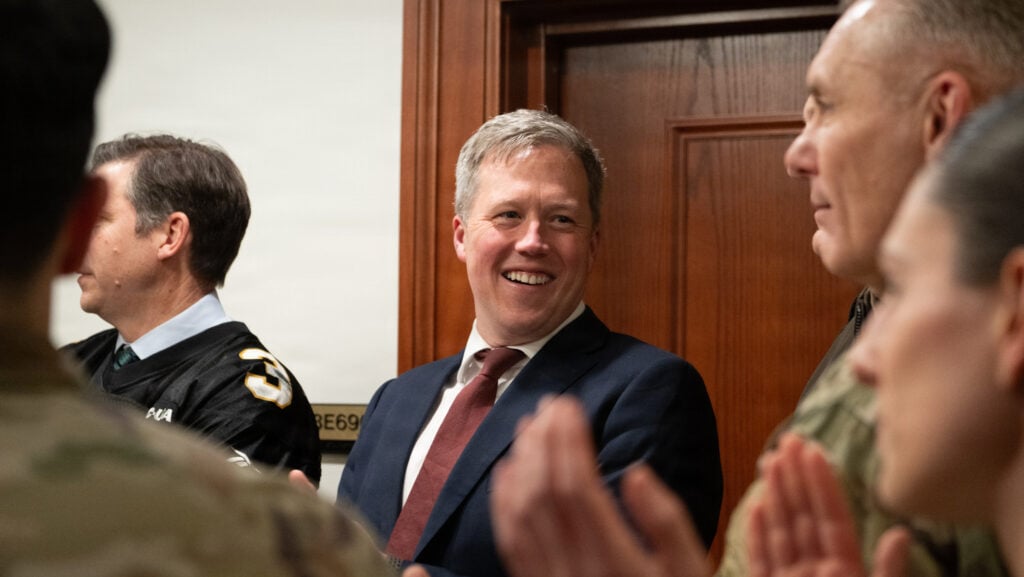
WASHINGTON — The Army plans to launch a new program to develop affordable interceptors while securing their intellectual property by partnering with nontraditional entities like academia, Army Secretary Dan Driscoll told reporters Wednesday.
“We the Army will either lease or purchase the IP, and then we want to see if we can create, from scratch, an interceptor that we can then own the IP for, and then go find contract manufacturing to build,” Driscoll said.
Interceptors, like the Patriot Advanced Capability-3 (PAC-3) Missile Segment Enhancement, can cost between $3 million and $4 million, but are reportedly being used to shoot down Iranian-made Shahed drones that cost just $4,000 in Operation Epic Fury, Driscoll explained. To create a more cost-effective system, the Army plans to break down the interceptor into subsegments and buy them — and their IP — separately, from cheaper manufacturers so the Army can own the entirety of the interceptor.
“If you took what a PAC-3 does and divide it into like, five or six subsegments, what do you actually need? One of the sub segments is a seeker, one is propulsion,” Driscoll said during a media roundtable. “What we’re starting to explore is, can we basically go out to the country and say, ‘Are you in a college lab? Are you a PhD who’s studying propulsion?’ … Hey, we’re breaking apart this problem. We want you to bring us all of the solutions.’”
Driscoll said he believes a “successful” interceptor shouldcost less than a quarter million dollars, but “some things” may be worth more. All in all, he said, if the interceptor costs five times of the target, “that would not be ideal.”
The issue of IP is one Driscoll has been insistent on since he took his post as the service’s secretary. Both he and head of the Army Material Command Lt. Gen. Christopher Mohan, ly warned companies they need to make their IP sharing rules more flexible or the Army will start 3D-printing parts of its own.
One of the large issues with the Army not owning its IP is that it doesn’t have the “right to repair,” meaning the service doesn’t have to rely on the manufacturer to fix broken parts, and can reverse engineer and 3D print parts on its own. If the Army owns the IP for the various interceptor sub segments, soldiers in the field can fix them in a timely manner, Driscoll ly explained.
Right now, the Army is in the “early stages” of the plan to acquire its own interceptor, Driscoll said Wednesday, adding that the official announcement for the plan will come in the four to six weeks. Driscoll said his goal is to have an Army-owned interceptor ready to launch within a calendar year of when he formally announces the plan.
“Basically the goal is: publicize it, break it into five or six different components, bring everyone to a range to show them how a couple of our things currently work, let them go work for four or five months — that would put six months in — and then have the first thing fired within a year. So one calendar year start to finish,” he said.