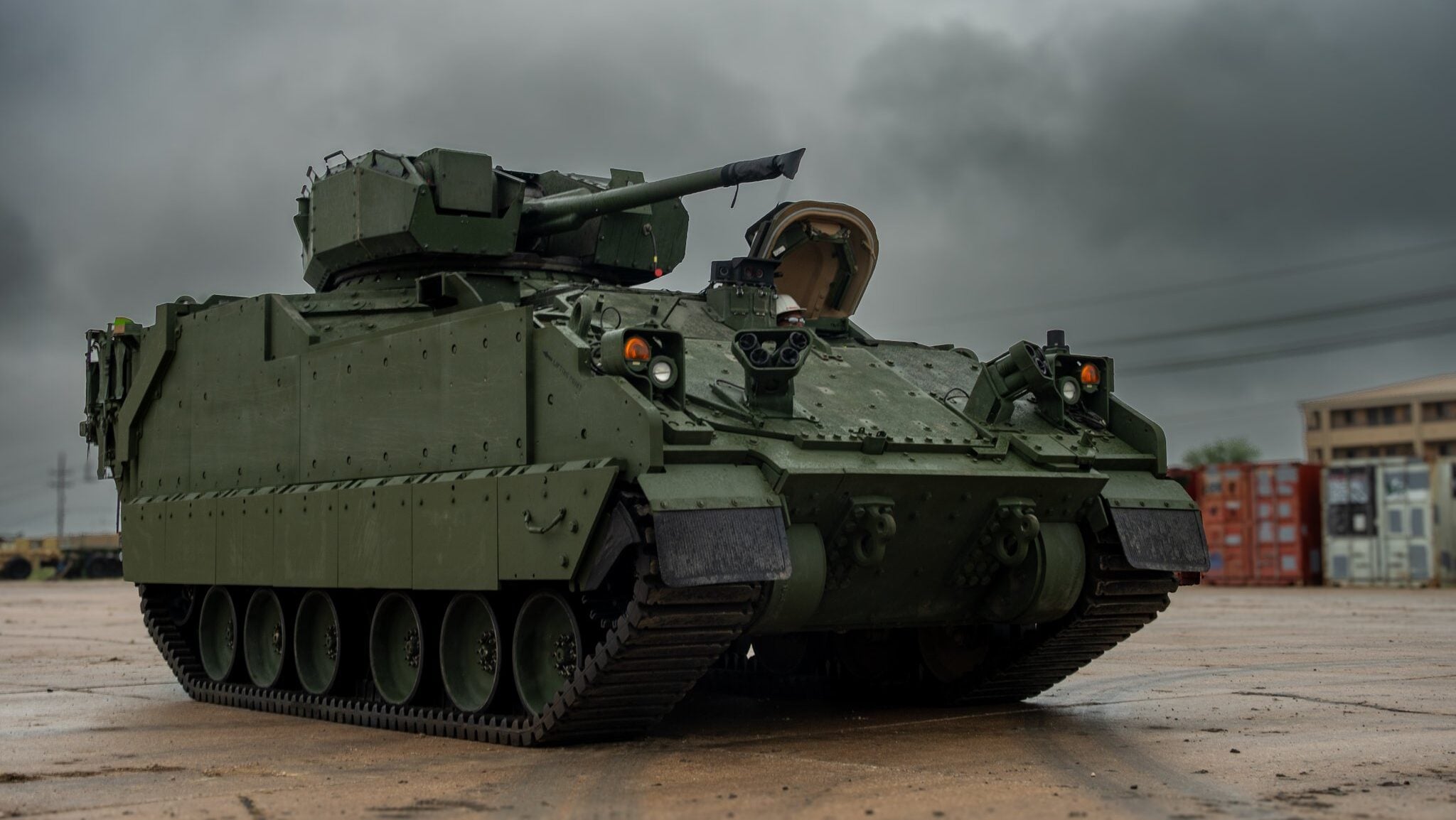
WASHINGTON — Amid speculation the Army could be shaking up its long, troubled quest to replace the Bradley Fighting Vehicle, BAE Systems and Kongsberg are sending two AMPV 30 prototypes to the service’s upcoming Transformation in Contact (TiC) 2.0 exercise with hopes of showing, as one Kongsberg executive put it, that there’s “something else out there.”
“The whole intent is at least to get the Army thinking,” Eskild Aas, director of programs at Kongsberg, told Breaking Defense. “That’s what we’re intending to do as well, is to place them side by side with Bradleys, and have Bradley crews operate the systems, and hopefully they will see that there’s something else out there.”
On April 30 the Army’s 1st Cavalry division announced in a social media post that it received BAE-made Armored Multi-Purpose Vehicles (AMPVs) outfitted with Kongsberg’s MCT-30 turrets for testingat TiC, calling the vehicles a “-generation capability.”
Aas acknowledged that the AMPV would not fit the bill for the Bradley’s official in-the-works replacement project dubbed XM30, and an Army spokesperson said flatly that “at this time, there is not an Army requirement for the AMPV 30, nor is it an Army funded program.”
“AMPV 30 is not the generation capability being integrated into the fight, that will be the XM30,” the spokesperson said. “AMPV 30 is not a replacement or candidate for the XM30 program.”
For one, AMPV is an armored personnel carrier, not an infantry fighting vehicle like the XM30 vehicles being developed by General Dynamics Land Systems and American Rheinmetall.
The AMPVs can carry anywhere from two to four crew members plus other soldiers or evacuees, depending on the variant, and the Bradley typically carries a crew of three plus a six soldier infantry squad. Additionally, APCs are typically less armored and have less fire power than IFVs, as the IFVs’s main goal is to fight alongside infantry.
But as Breaking Defense reported in February, there are signs that the service appears to be open to rethinking what it needs in a Bradley replacement beyond the XM30.
Aas said Kongsberg sees TiC, an exercise devoted to integrating new tech into units that aren’t necessarily associated with a program of record or set requirements, as a way to offer something a little different.
“What we want to show is something that is in production. It’s high maturity, it’s readily available, and at a significantly lower price point compared to what the XM30s, or what we’re assuming XM30s cost, right?” Aas said. (The AMPV base vehicle is in production, but the 30 variant with the Kongsberg turret is not.)
“XM30 has very stern requirements, and we’re not really looking to [do] that. This will be something else,” he continued. “So it fits a different envelope than XM30.”
Further, Aas said that the AMPV 30 has counter-unmanned aerial system technology, and according to a recent Congressional report, “it is not clear if the XM30 also will have an organic C-UAS capability.”
A BAE spokesperson told Breaking Defense this week that the company defers any “specific mission evaluation or testing the TiC has planned to the Army.” However, the spokesperson added that “it’s critical that soldiers have the capabilities they need to win the fight and that the Army has viable options for its combat vehicle needs.”
“Our push for combat vehicle innovation never stops and providing the Army with -generation options is part of our ongoing commitment to modernize at pace,” they added.
The Army did not respond to a request for comment by press time on how it plans to test the vehicles during TiC this summer.
As Breaking Defense ly reported, analysts and former defense officials pointed to the AMPV 30 as a possible alternative for the XM30, though they noted the vehicle with the new turret configuration specificallyis not in production and would likely require more testing to prove out changes and modifications. One of those former defense officials went a bit further this week, telling Breaking Defense that pursuing it would be “poor substitute” due to “capability, schedule, cost, future upgrade ability, etc.”
That said, the former defense official, said there could be other uses for an AMPV 30 within the force if the service and BAE is willing to do “a lot more work.”
For example, it could be used as an air defense or counter-drone platform, for former defense official said.
“It would need to be fitted with radar and then fully integrated,” the former defense official added. “While that’s possible, that’s not quick and wouldn’t be evaluated during TiC.”