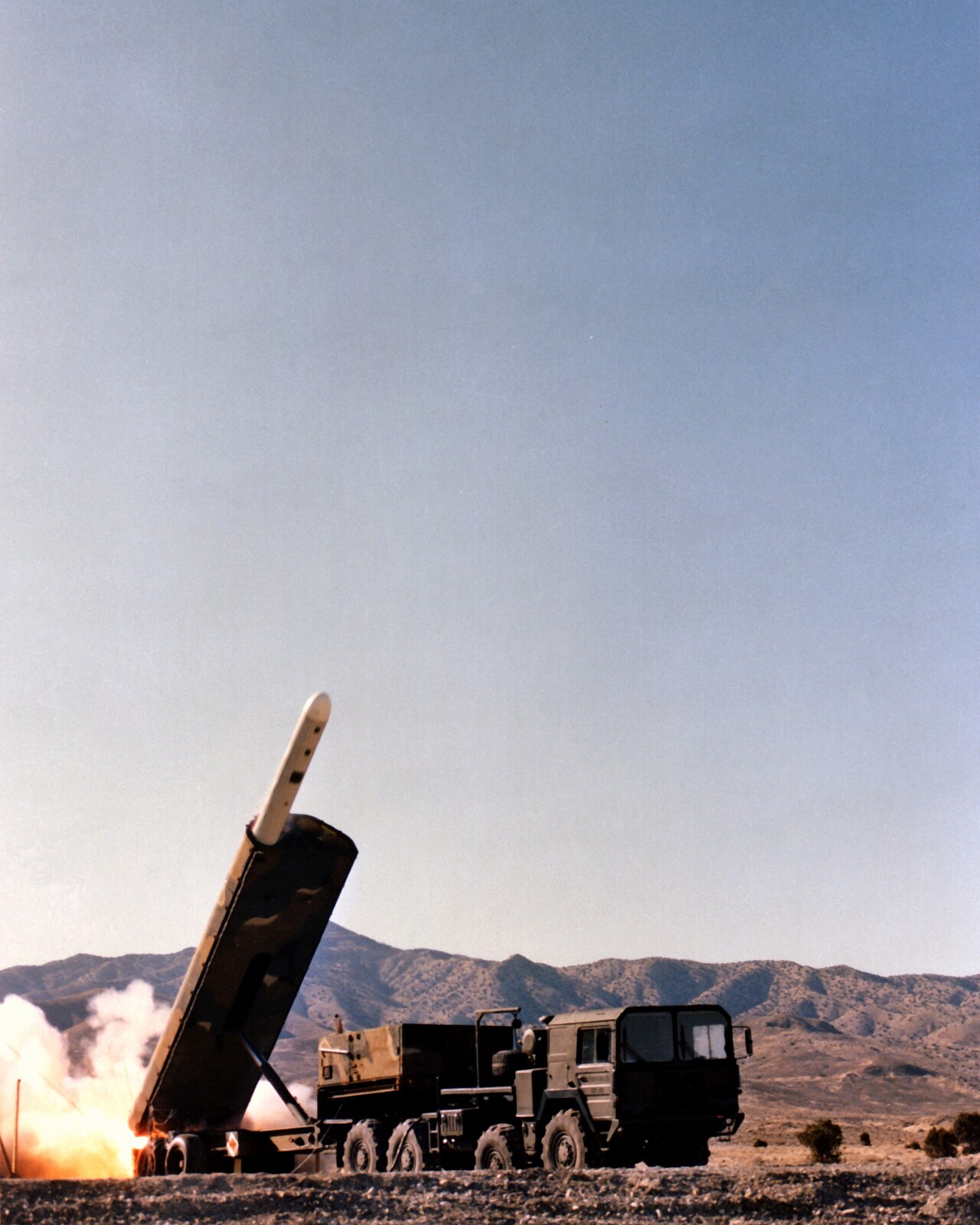
DETROIT — Divergent Technologies will begin 3D printing a key portion of the Tomahawk cruise missile year, as it stands up a new production facility in Long Beach, Calif., the company’s chief executive told Breaking Defense on Tuesday.
Once up and running, the new 430,000-square-foot “Factory 2” will be able to deliver upward of 30,000 missile airframes or 60,000 warhead casings per year, depending on the needs of the Pentagon, the company said in a news release announcing the new factory. The added capacity will allow Divergent to increase annual production eightfold for defense and commercial customers, the release stated.
Divergent’s recent contract with RTX’s Raytheon to come onboard as a second source of the Tomahawk’s midbody structure is a key part of its planned ramp up, Divergent CEO Lukas Czinger said during an interview on the sidelines of the Reindustrialize Summit.
“We have started our initial test unit, so we have our first prototypes. We would aim for production start in the first half of year. That, again, is a great thing to do in Factory 2,” he said.
Divergent is one of several emerging technology firms scoped around using the latest advances in 3D printing, robotics and software to manufacture components for defense primes and customers in other markets — in essence, making the structure or parts of missiles and airframes instead of designing weapons and drones.
The Tomahawk midbody contract will support Raytheon as it boosts production of the cruise missile under a multiyear framework deal with the Pentagon announced earlier this year.
While a finalized contract between Raytheon and the department is not expected until Congress passes a fiscal 2027 budget, Czinger said Raytheon has already put Divergent under contract in advance of the final deal to ensure it has a diverse and steady supply chain when the orders come in.
“We need all hands on deck, we need as many of these as we can possibly get, and Divergent is good complimentary supply for [Raytheon],” he said. “They’re not getting all the volume they need out their existing solutions.”
Divergent is also under contract to build structures for several companies, including CoAspire, for the Air Force’s Family of Affordable Mass Missile program and the Low Cost Containerized Munitions Program. (As a supplier, Divergent does not have permission to publicly name all of its customers.)
Although not purpose-built to accommodate munitions production — Divergent notes that the facility will also be capable of printing automotive components and other parts for commercial manufacturing — Czinger told Breaking Defense that about 80 percent of the new factory was driven by growth in defense contract volume.
“We’re continuing our tier one supply and auto [businesses], but three years ago we said we’re really going to take this time to grow in defense,” he said. “Three years from now, that same factory could go to majority auto hypothetically … but today it’s really anchored by defense programs.”
The Long Beach production hub will house Divergent’s new series of 3D printers, known as Monolith One. A total of 64 machines will fit into the factory.
The new machines, which are made in-house by the company, double production throughput compared to other 3D printers and lower the cost per unit, Czinger said.
“It’s got the highest laser power of any machine on the market, it’s got the most advanced gas flow and powder delivery system of anyone on the market,” Czinger said.