Cybersecurity
539 articles · Coverage updated continuously

While the cybersecurity industry has heavily invested in defending against complex threats like zero-days and sophisticated AI-generated exploits, the most persistent and effective initial access vector for attackers remains alarmingly simple: stolen credentials. These identity-based attacks, which bypass traditional defenses by leveraging valid login information, are now being dramatically accelerated by advancements in artificial intelligence. This escalation means that attackers can scale operations, create custom tools, and craft highly realistic phishing campaigns at unprecedented rates.

A new NGate Android malware campaign is actively targeting users in Brazil, weaponizing the legitimate HandyPay application to steal NFC payment card data and PINs. This sophisticated attack enables threat actors to execute contactless ATM cash-outs and unauthorized transactions, marking a dangerous escalation in mobile financial fraud. Notably, researchers suggest the malicious code itself may have been AI-generated, pointing to a worrying new frontier in cybercriminal capabilities.

New research from Check Point reveals a staggering scale of compromise linked to The Gentlemen ransomware-as-a-service (RaaS) operation, uncovering over 1,570 victims through an exposed SystemBC command-and-control server. This discovery far exceeds the public victim count on the group's data leak site, underscoring the true reach of ransomware operations often hidden beneath the surface. Threat actors associated with The Gentlemen RaaS have been actively deploying SystemBC proxy malware to establish SOCKS5 tunnels, facilitating remote access and further payload delivery.

As cyber threats evolve, the Mean Time To Respond (MTTR) becomes a critical metric for organizational resilience, directly impacting data security, service continuity, and brand reputation. Leadership views slow MTTR not just as an operational KPI, but as an escalating risk of data exfiltration and business disruption. This article explores how mature Security Operations Centers (SOCs) are fundamentally restructuring their approach to threat intelligence to drastically cut down response times.

In a disturbing case of insider sabotage, ransomware negotiator Angelo Martino has pleaded guilty to colluding with the notorious BlackCat ransomware group and two other incident responders, providing confidential client data to maximize ransoms. Martino, who worked on behalf of five ransomware victims, secretly supplied BlackCat with sensitive information like insurance limits and negotiation strategies between April and November 2023, ultimately leading to the seizure of $10 million in assets from him. This marks the third instance of a ransomware negotiator facing charges for actively participating in extortion schemes, underscoring a troubling trend within the incident response sector.

Google has significantly bolstered web security for Windows users with the general availability of Device Bound Session Credentials (DBSC) in Chrome 146, a move aimed squarely at neutralizing the persistent threat of session theft. This crucial update cryptographically ties authentication sessions to a user's device, leveraging hardware-backed security to render stolen cookies useless to attackers. Months after its beta rollout, DBSC's broader release marks a major step in Google's fight against prevalent info-stealer malware families that routinely compromise user sessions.
A new report reveals that AI browser extensions are creating a critical, ungoverned AI consumption layer within enterprises, operating unseen and bypassing traditional security controls like DLP and SaaS logs. With one in six users employing these tools, which are 60% more vulnerable than average extensions, they present an unprecedented risk of sensitive data leaks. These extensions gain direct access to enterprise data, user inputs, and session tokens, posing a hidden but pervasive threat that has largely escaped security radars.

The GlassWorm campaign has taken another dangerous leap, now employing a novel Zig-compiled Node.js native addon to covertly compromise developer Integrated Development Environments (IDEs). This sophisticated new dropper, disguised within seemingly innocuous Open VSX extensions, targets not just VS Code but also VSCodium and various AI coding environments, marking a significant escalation in its stealth and reach across a developer's machine.

Adobe has issued urgent emergency patches for a critical Acrobat Reader flaw, CVE-2026-34621, which has been actively exploited as a zero-day vulnerability in the wild since late 2025. This prototype pollution issue allows for arbitrary code execution and has garnered a CVSS score of 8.6, prompting CISA to add it to its KEV catalog and mandate federal agencies apply fixes by April 27, 2026.

OpenAI has revoked its macOS app certificates following a supply chain compromise involving a malicious version of the Axios library, downloaded through a GitHub Actions workflow used for app signing. Attributed to the North Korean group UNC1069, this incident deployed the WAVESHAPER.V2 backdoor, prompting the AI giant to act with an "abundance of caution" despite no evidence of user data exfiltration or system compromise. The move underscores the pervasive threat of supply chain attacks, even for leading technology firms.
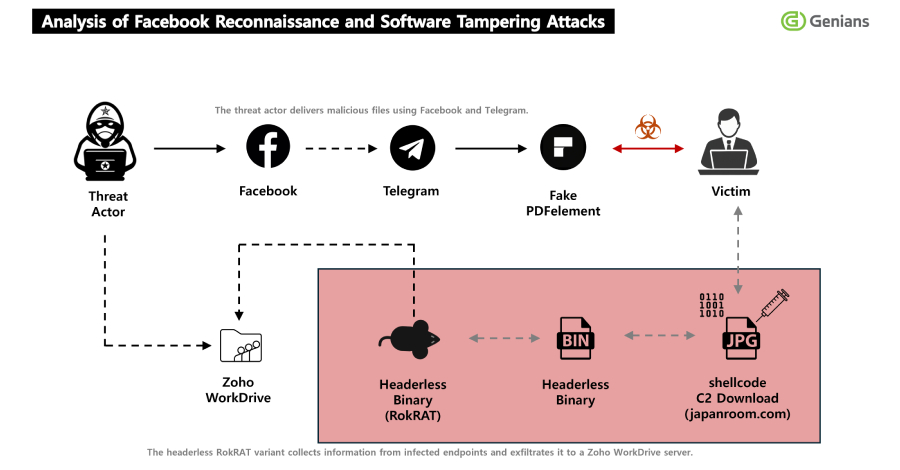
North Korea's advanced persistent threat group, APT37 (also known as ScarCruft), is behind a new multi-stage spear-phishing campaign that leverages Facebook social engineering to compromise military targets. The sophisticated operation involves building trust with victims via friend requests and Messenger conversations before luring them into installing a trojanized PDF viewer to deliver the RokRAT remote access trojan, under the guise of accessing encrypted military documents. This method highlights an evolving threat landscape where social media platforms are exploited as primary attack vectors.
As Anthropic abruptly restricted its Mythos Preview model last week after it demonstrated the capacity to autonomously exploit zero-day vulnerabilities across major operating systems and browsers, the cybersecurity industry grapples with an accelerating threat landscape. While improvements in Mean Time To Detect (MTTD) are celebrated, the true Achilles' heel for Security Operations Centers (SOCs) remains the critical 'post-alert gap' in human-driven investigations. AI is now emerging as the transformative solution to bridge this chasm, offering real-time context and analysis to neutralize threats operating on timelines measured in seconds.